
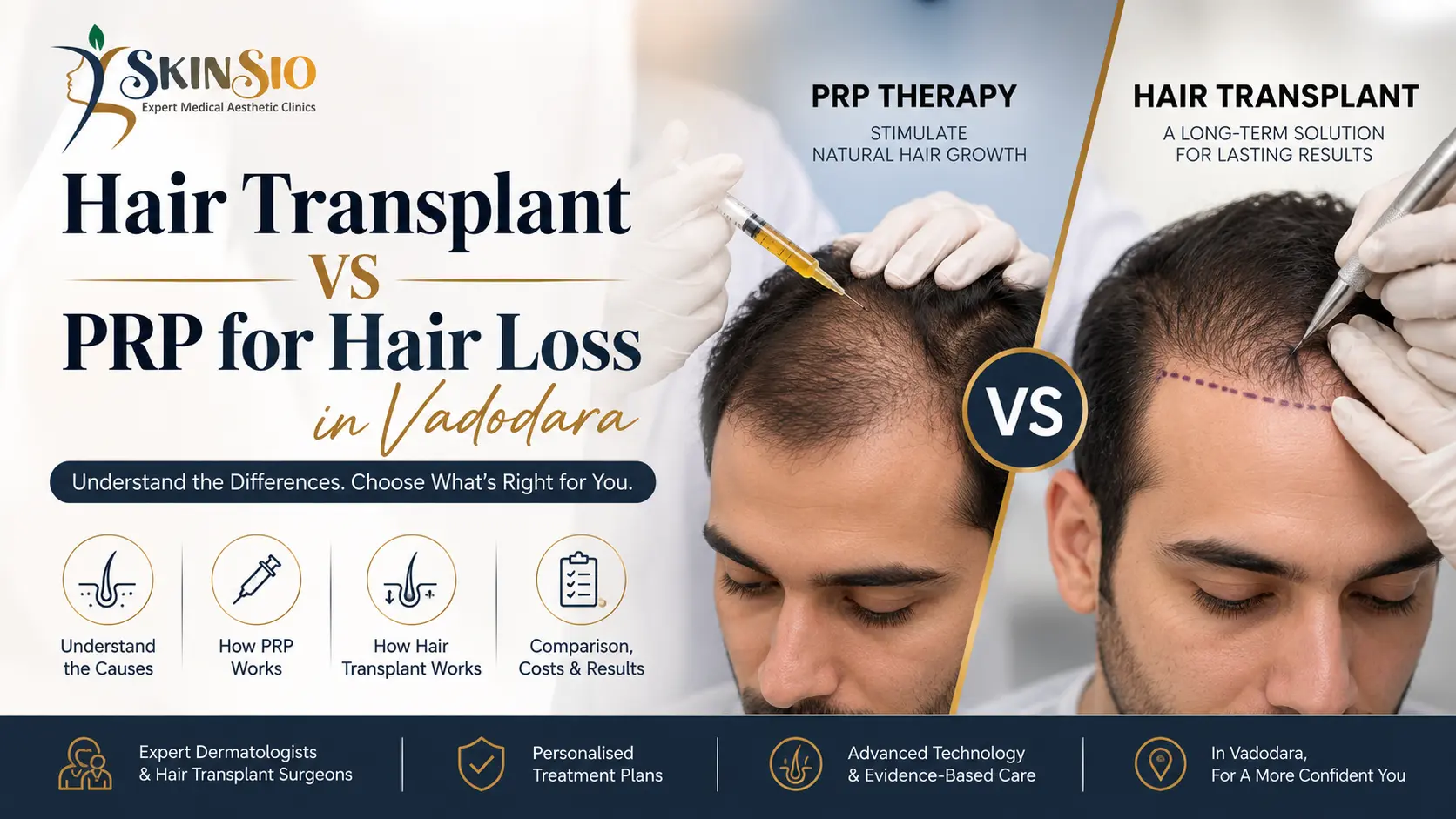
Hair Transplant vs PRP: Why This Isn't a "Which Is Better" Question
Finding more hair than usual on your pillow, in the shower drain or on your comb can be unsettling — and the question that usually follows is: "Should I get PRP, or do I need a hair transplant?"
These two treatments are frequently discussed together, but they are not interchangeable, and they are not competing for the same job. PRP is a non-surgical treatment prepared from a concentrated component of your own blood, used in appropriately selected patients with hair thinning. A hair transplant is a surgical procedure that relocates hair follicles from a donor area to areas affected by hair loss.
So if you're comparing PRP vs hair transplant in Vadodara, the most useful question isn't which treatment is "better" in the abstract. It's: which treatment matches the type and stage of your hair loss? That depends on whether your follicles are still producing hair, how advanced the thinning is, the quality of your donor area, your age, your hair-loss pattern, and whether any underlying cause is being medically managed. At SkinSio Clinics, Vadodara, hair restoration begins with understanding the cause and pattern of hair loss — not with defaulting to whichever procedure is being marketed most aggressively that month. This mirrors the diagnosis-first approach we take across our broader hair fall treatment guide.
PRP vs Hair Transplant: The Simplest Way to Think About It
PRP aims to support existing hair follicles. A hair transplant redistributes viable donor follicles that are already present elsewhere on the scalp. That distinction explains why someone with early thinning may be considered for medical treatment and/or PRP, while someone with an established area of baldness and a suitable donor area may instead be evaluated for transplantation. Neither treatment is automatically appropriate for every type or stage of hair loss.
What Is PRP for Hair Loss?
PRP stands for Platelet-Rich Plasma. A small sample of the patient's blood is drawn and processed to concentrate platelets within the plasma. This preparation is then injected into selected areas of the scalp. The aim is to support hair growth and improve the condition of existing follicles in appropriately selected patients — it is generally a non-surgical procedure and does not create a new supply of donor hair.
PRP may be considered when hair is thinning but follicles are still present, hair density has gradually reduced, early-to-moderate pattern hair loss is being evaluated, a patient wants a non-surgical option, or PRP is being used as an adjunct to another hair-restoration strategy. However, PRP is not a guaranteed cure for hair loss, and results vary between individuals. Our dedicated PRP therapy guide covers the evidence, session counts and safety profile in more depth.
What Happens During a Hair Transplant?
A hair transplant works on a fundamentally different principle. Instead of attempting to stimulate existing follicles, a surgeon removes hair follicles from a suitable donor area — usually the back or sides of the scalp — and places them into areas affected by hair loss. There are two commonly discussed donor-harvesting approaches:
FUE (Follicular Unit Excision) — individual follicular units are extracted from the donor area using a small punch, then placed into prepared recipient areas.
FUT (Follicular Unit Transplantation) — a strip of tissue containing hair follicles is removed from the donor area and dissected into individual follicular-unit grafts.
FUT leaves a linear donor scar, while FUE produces multiple small donor-site scars — contrary to some marketing claims, hair transplantation is not literally "scarless." The appropriate technique depends on the patient's characteristics, goals, donor area and surgeon's assessment.
The Biggest Question: Do You Still Have Hair to Save?
This is perhaps the most useful way to frame the decision. Imagine the scalp as a garden. If the plants are weak but still alive, improving their environment may help. But if an area has lost the plants entirely, simply improving the soil there won't recreate them. Similarly, PRP may be considered to support existing follicles, whereas transplantation can move viable follicles into areas where density has already been lost.
This is why someone with diffuse early thinning should not automatically jump to a transplant — and why someone with a clearly established bald area shouldn't assume repeated PRP injections will recreate the density that transplantation could potentially provide.
PRP vs Hair Transplant: Side-by-Side Comparison
| Feature | PRP Therapy | Hair Transplant |
|---|---|---|
| Type | Non-surgical procedure | Surgical hair-restoration procedure |
| Main concept | Supports existing follicles | Redistributes donor follicles |
| Creates new follicles? | No | No — existing follicles are moved |
| Donor hair required? | No | Yes |
| Suitable for | Selected thinning/hair-loss patterns | Selected patients with sufficient donor hair |
| Recovery | Usually relatively short | Requires postoperative recovery |
| Results | Gradual and variable | Gradual, transplanted hair needs time to grow |
| Maintenance | Often required | Native hair may continue to thin |
| Permanence | Not a permanent replacement for lost follicles | Transplanted follicles can provide long-term restoration when appropriately selected |
| Surgery | No | Yes |
| Can they be combined? | Sometimes | Sometimes |
The important point is that PRP and transplantation solve different problems.
Which Gives Faster Results?
Neither should be sold as an overnight solution.
With PRP: any improvement generally takes time, and multiple treatments may be recommended depending on the patient's condition and protocol.
With hair transplantation: transplanted hairs do not immediately become thick new hair. It is normal for transplanted hair to shed temporarily after the procedure. New growth develops gradually, with many patients seeing meaningful results several months after surgery — results commonly become visible around 6–9 months, with some patients taking up to 12 months.
Therefore: PRP is a gradual biological response, while a transplant involves gradual growth of transplanted follicles.
Is a Hair Transplant Permanent?
This deserves an important clarification. A properly selected hair transplant can provide long-term restoration from transplanted donor follicles, but it does not necessarily stop the underlying process of hair loss. Your original, non-transplanted hair can continue to thin over time. Medication may be recommended after transplantation precisely because ongoing hair loss can continue even after surgery.
That's why a good hair-restoration plan isn't simply "how many grafts do I need?" It should also ask: "how do we preserve the hair I still have?"
Can PRP and Hair Transplant Be Used Together?
Yes, in selected patients. PRP may be used as an adjunct around hair transplantation, although evidence and protocols vary, and it should not be presented as something every transplant patient automatically needs. Some hair-restoration protocols use PRP around the time of transplantation with the aim of supporting healing or early growth. PRP is generally discussed as an adjunct to established medical management rather than a substitute for it, and hair-transplant practice guidance describes potential perioperative uses while noting limitations in the current evidence.
So the more accurate statement is: PRP and hair transplantation can sometimes complement each other — but one does not replace the other.
What About Hair Loss in Your 20s?
This is where rushing into a transplant can become a genuine problem. Someone in their early 20s with rapidly progressing hair loss may not be an ideal immediate transplant candidate, because hair loss can continue to progress. If transplantation is performed too early without considering future loss, the patient may eventually have transplanted hair surrounded by progressively thinning native hair.
Caution is generally recommended in young patients with early, evolving pattern hair loss, with an emphasis on stabilisation and appropriate medical treatment before transplantation in many cases. Therefore, young age isn't automatically a reason to avoid transplantation — but it is a reason for careful assessment and long-term planning.
What If Your Hair Loss Isn't Male or Female Pattern Baldness?
This is extremely important. Not every case of hair fall is androgenetic alopecia. Hair loss can also occur due to nutritional deficiencies, thyroid disorders, recent illness, major stress, certain medications, alopecia areata, scalp disorders, hormonal conditions, post-pregnancy changes, and other medical causes.
A hair transplant does not treat the underlying cause of many of these conditions. That's why diagnosis comes before procedure — determining the cause of hair loss is an important part of choosing the appropriate treatment.
So, Should You Choose PRP or Hair Transplant?
Here's a practical way to think about it:
You may be evaluated for PRP when:
- You have thinning rather than extensive baldness
- Viable follicles are still present
- You want a non-surgical option
- Your dermatologist believes PRP may be useful as part of your treatment plan
You may be evaluated for hair transplantation when:
- There is established pattern hair loss
- There are areas where density has significantly reduced
- You have an adequate donor supply
- Your hair-loss pattern is sufficiently understood and stable
- Your expectations are realistic
A hair transplant is not simply a cosmetic "fill-in" procedure. Donor hair is a limited resource, and planning its use carefully genuinely matters.
Cost Considerations: PRP vs Hair Transplant in Vadodara
Cost is one of the first things patients search for — but comparing a single PRP-session price with a hair-transplant price isn't particularly useful, because they are fundamentally different treatment models.
PRP cost can depend on: number of sessions, treatment protocol, preparation method, whether it's combined with other treatments, and maintenance requirements. Our PRP therapy guide breaks down what genuinely affects PRP pricing, including tube and consumable quality.
Hair-transplant cost can depend on: number of grafts required, size of the recipient area, donor density, technique, surgical complexity, surgeon and clinical team, postoperative care, and whether additional sessions may eventually be required.
This is why a responsible clinic should assess the patient before giving any transplant estimate — and why choosing a clinic solely because it advertises the lowest price per graft is a genuine risk. Our guide to choosing a skin clinic in Vadodara covers the questions worth asking before committing to any surgical procedure.
What Should You Ask Before Choosing a Hair Transplant Clinic in Vadodara?
Before committing to surgery, ask: Who will diagnose my hair loss? Is my hair loss stable? Do I actually need a transplant now? How many grafts do I need, and why? How strong is my donor area? What happens to my existing hair after transplantation? What will my hairline look like in 5–10 years? Who performs the critical surgical steps? What are the possible complications? What is the postoperative plan?
Patients are generally advised to ask about the surgeon, surgical options, FUE vs FUT, risks, costs, and who will be involved in the procedure before proceeding.
7 Red Flags to Watch for When Choosing a Hair Transplant
Be cautious of clinics promising:
- "100% guaranteed results" — no legitimate medical procedure can guarantee identical results for every patient
- "Scarless hair transplant" — FUE can minimise the appearance of donor scarring, but it is not literally scarless
- "Unlimited grafts" — your donor supply is finite
- "Hair transplant without diagnosis" — the cause and pattern of hair loss should always be assessed first
- "One treatment permanently stops hair loss" — transplantation does not necessarily stop ongoing native-hair loss
- "Everyone needs PRP" — PRP is not automatically indicated for every patient
- "Guaranteed full head of hair" — the realistic goal is improvement in density and appearance, not an unlimited supply of donor hair
Why Your Diagnosis Matters More Than the Procedure
Two people can walk into the same clinic with the same complaint — "my hair is falling" — but their treatment plans could be completely different. One may have early androgenetic alopecia. Another may have telogen effluvium after illness or stress. Another may have nutritional or hormonal factors. Another may have advanced pattern hair loss with a suitable donor area. And another may have a scalp disorder requiring medical treatment first.
That's why "PRP vs transplant" should come after diagnosis, not before it.
A More Sensible Treatment Path at SkinSio Clinics
At SkinSio Clinics, the approach to hair restoration is staged rather than procedure-first:
Step 1 — Diagnose. Determine the likely cause and pattern of hair loss.
Step 2 — Assess the scalp and donor area. Understand existing density, miniaturisation and the potential donor supply — often using trichoscopic scalp examination, as covered in our hair fall treatment guide.
Step 3 — Stabilise ongoing hair loss. Medical management may be important depending on the diagnosis.
Step 4 — Decide whether PRP has a role. PRP may be considered for appropriately selected patients.
Step 5 — Evaluate transplant candidacy. If significant permanent density loss exists and the donor supply is suitable, transplantation may be considered.
Step 6 — Plan for the future. A good hairline today should still look appropriate as you age.
The Bottom Line: PRP or Hair Transplant?
If your hair is thinning but the follicles are still present, PRP may be one component of a non-surgical or combination treatment plan. If you have established areas of permanent density loss and an adequate donor area, a hair transplant may be considered. And sometimes the answer is PRP plus medical treatment plus monitoring — or medical treatment first, transplant later — or transplant plus ongoing treatment to protect native hair.
The right answer isn't determined by the trendiest procedure or the cheapest package. It starts with understanding why you're losing your hair.
Hair Restoration at SkinSio Clinics, Vadodara
SkinSio Clinics provides hair-restoration services in Vadodara, including hair-fall management, PRP and hair-transplant guidance, with FUE evaluation available and women assessed for transplantation after appropriate assessment where relevant. If you're unsure whether you need PRP, medical hair-loss treatment, a hair transplant, or a combination approach, a professional hair and scalp assessment is the sensible first step.
Don't choose the procedure first. Find out what your hair actually needs.
Book a Hair Loss Consultation in Vadodara
At SkinSio Clinics, Manjalpur, Vadodara, our team assesses your hair-loss pattern, donor availability and underlying cause before recommending PRP, transplant referral, medical management, or a combination. Call or WhatsApp +91 93220 22392 to book a consultation.
Frequently Asked Questions
Is PRP better than a hair transplant?
Neither is universally better — they are different treatments for different situations. PRP is generally considered for appropriately selected patients with thinning hair where follicles are still present, while a hair transplant may be considered when there is established, permanent density loss and a suitable donor area. The right choice depends on diagnosis, not preference.
Can PRP replace a hair transplant?
Generally no. PRP is intended to support existing follicles in appropriately selected patients, but it cannot recreate follicles in an area where they have been permanently lost. If donor-quality hair is genuinely absent from a region of the scalp, PRP alone is unlikely to restore visible density there.
Can I have PRP before or after a hair transplant?
PRP may be considered as part of some hair-restoration plans, including around the time of a transplant, but it is not necessary for every patient. Whether it has a role in your specific case should be decided by your treating doctor after assessment.
Is FUE better than FUT for hair transplant?
Neither technique is universally superior. FUE and FUT are different donor-harvesting methods with different scarring patterns, recovery profiles and suitability depending on the patient's donor density, goals and surgical plan.
How long does it take to see results from a hair transplant?
Hair growth after transplantation is gradual. Transplanted hair typically sheds temporarily before new growth begins, with many patients seeing meaningful results several months later — commonly reported in the range of 6 to 12 months for fuller results to develop.
Does PRP permanently stop hair loss?
No. PRP should not be presented as a permanent cure for progressive hair loss. Maintenance sessions may be recommended, and addressing the underlying cause of hair loss — through medical evaluation and, where appropriate, treatment — remains important.
Is a hair transplant permanent?
Transplanted donor follicles can provide long-term restoration in appropriately selected patients, but the patient's existing, non-transplanted hair may continue to thin over time due to the same underlying process. Ongoing medical management is often still recommended after transplantation.
How much does a hair transplant cost in Vadodara?
There is no single citywide figure, because cost depends on factors such as the number of grafts required, donor density, surgical technique and complexity. A proper in-person assessment is needed before any individualised estimate can be given.
What is the best hair loss treatment in Vadodara?
There is no single best treatment for every patient. The appropriate approach depends on the cause, severity and pattern of hair loss, the condition of existing follicles, donor availability, and the patient's specific goals — which is why diagnosis should always come before choosing PRP, transplant, or a combination.