Laser Hair Removal in Vadodara: Is It Worth It?
Laser hair reduction (LHR) is one of the fastest-growing aesthetic treatments in India — and Vadodara is no exception. Rising disposable incomes, increasing beauty awareness, and a shift away from painful waxing cycles have made laser hair removal the preferred long-term solution for both men and women across Gujarat.
The India laser hair removal devices market was valued at approximately US$25 million in 2023 and is projected to reach US$54 million by 2030, growing at 11.5% annually. Globally, the market is on track to reach nearly US$5 billion by 2032. Asia-Pacific — driven by India's large population and rising middle class — accounts for a 22% share of global demand and is the fastest-growing region.
At SkinSio Clinics, Vadodara, we offer medical-grade diode laser hair removal under qualified dermatological supervision — with protocols tailored specifically for Indian skin types.
How Laser Hair Removal Works
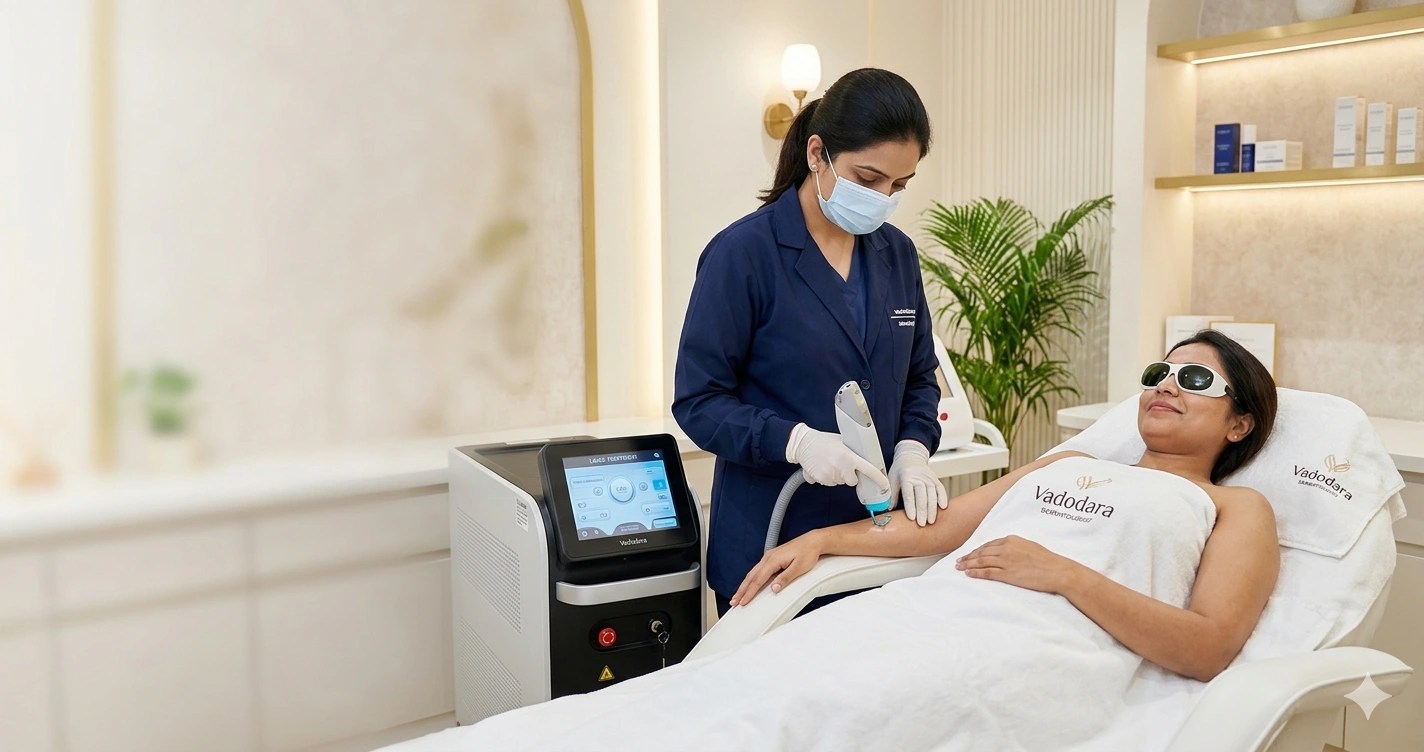
LHR uses a principle called selective photothermolysis: laser light (typically 600–1,200 nm wavelength) targets the melanin pigment in hair follicles, generating heat that disables the follicle while sparing surrounding skin tissue.
Because hair follicles cycle through growth phases asynchronously, only follicles in the active anagen (growth) phase are effectively treated in any single session. This is why multiple sessions are essential — each session catches a new batch of follicles in the growth phase.
Laser Technologies Compared: Diode, Nd:YAG and IPL
Not all laser devices are equal. Understanding the difference helps you choose the right clinic.
| Technology | Wavelength | Best For | Indian Skin Safety |
|---|---|---|---|
| Diode Laser | ~810 nm | All skin types; gold standard for most patients | Excellent — with cooling |
| Nd:YAG Laser | 1064 nm | Dark or tanned skin; deeper follicles | Safest for Fitzpatrick IV–VI |
| Alexandrite Laser | 755 nm | Light skin with fine hair | Caution on darker tones |
| IPL (Broadband) | 500–1200 nm | Salons and home devices | Not recommended for Indian skin |
| Triple Wavelength | 755 + 810 + 1064 nm | All hair types simultaneously | Excellent across all skin tones |
The diode laser is considered the gold standard for Indian skin — it balances melanin absorption and penetration depth, and modern devices use a sapphire cooling tip (–5°C contact cooling) to protect the epidermis and make each pulse feel like a warm massage rather than a snap. IPL, by contrast, scatters energy broadly and is poorly suited for permanent reduction on deeper Indian skin tones.
At SkinSio Clinics, Vadodara, we use a medical-grade cooled diode laser system, with Nd:YAG settings available for darker or tanned skin, ensuring both safety and efficacy across all Fitzpatrick types.
Treatment Protocol: Sessions, Spacing and Maintenance
Laser hair removal is not a one-time procedure. The standard protocol for most patients is 6–8 sessions, spaced 4–6 weeks apart, to catch all follicles across different growth cycle phases. At SkinSio Clinics, sessions are typically scheduled at monthly intervals, with spacing adjusted based on hair density and body area.
After completing the initial course, most patients maintain results with 1–2 maintenance sessions per year, targeting any fine regrowth. With quality equipment and appropriate settings, patients typically achieve 70–90% permanent hair reduction after the full course — far superior to the 12+ sessions often needed with cheaper IPL devices, which also produce inferior long-term outcomes.
Package Pricing: SkinSio Clinics vs Market Rates in Vadodara
Below is a comparison of SkinSio Clinics' 6-session package pricing against typical market rates in Vadodara and Gujarat. All prices are for a complete 6-session course.
| Treatment Area | SkinSio Clinics (6 sessions) | Typical Market (6 sessions) | Expected Outcome |
|---|---|---|---|
| Full Body | ₹50,000 – 1,25,000 | ₹1,20,000 – 2,00,000 | 70–90% reduction in 6–8 sessions |
| Full Face | ₹12,000 – 15,000 | ₹40,000 – 65,000 | 60–80% reduction (dark hair only) |
| Bikini Area | ₹12,000 – 20,000 | ₹18,000 – 21,000 | Near-complete reduction |
| Full Arms | ₹12,000 – 20,000 | ₹15,000 – 24,000 | Significant thinning |
| Full Legs | ₹15,000 – 25,000 | ₹15,000 – 24,000 | Significant thinning |
| Underarms | ₹12,000 – 15,000 | ₹12,000 – 15,000 | Near-complete clearance |
SkinSio's competitive pricing reflects the use of high-quality diode laser technology and volume discounts on package deals. Package sessions are typically 20–30% cheaper per session than single-session pricing. Higher market rates at large chains often reflect franchise overheads and marketing spend rather than superior clinical outcomes.
Why Laser Hair Removal Pricing Varies So Much
Patients often ask why two clinics in the same city charge very different rates for the same area. The key pricing factors are:
- Laser technology — Medical-grade diode or multi-wavelength systems cost significantly more than cheap IPL devices. Better machines achieve results in fewer sessions.
- Doctor supervision — A board-certified dermatologist overseeing each treatment adds safety and accountability, and justifies a higher fee. Guidelines in India emphasise that laser procedures must be performed or directly supervised by a qualified physician.
- Hygiene and safety standards — Sterile gel, single-use tips, protective eyewear, patch testing, and clinical-grade cooling all add to operating cost.
- Clinic overhead — Prime location clinics in Vadodara carry higher rent and staffing costs than neighbourhood salons.
- Staff training — Certified laser technicians with formal training under doctor oversight command higher salaries than untrained salon staff.
Spending more upfront on a quality clinic typically yields faster results, safer outcomes, and fewer total sessions — making it better value in the long run than multiple cheap treatments that fail to deliver permanent reduction.
Indications and Contraindications
Laser hair removal is suitable for most adults with dark, coarse unwanted hair. Common indications include aesthetic hair removal on face, arms, legs, underarms and bikini line; medical conditions such as hirsutism, pseudofolliculitis barbae (razor bumps), and pilonidal sinus; and patients who cannot tolerate the pain or skin trauma of repeated waxing.
Contraindications include:
- Pregnancy — safety data is insufficient; treatment should wait until after childbirth
- Active skin infections (impetigo, active herpes) in the treatment area
- Patients currently on oral isotretinoin or within 6–12 months of completing it
- Tattoos or pigmented lesions within the treatment zone
- History of keloid scarring (relative contraindication; discuss with dermatologist)
- Very light blonde, white, or grey hair — insufficient melanin for the laser to target
At SkinSio Clinics, every patient undergoes a dermatologist's consultation and a test patch before commencing treatment to confirm suitability and determine optimal laser settings.
Side Effects and Safety
When performed by trained professionals with appropriate equipment, LHR is a safe procedure. The most common post-treatment effects are temporary redness and mild swelling — similar to a mild sunburn — that resolve within 1–2 days. SkinSio's cooled diode laser minimises discomfort significantly, with most patients describing treatment as a warm, tolerable sensation.
Rare but possible side effects include:
- Burns or blisters — Caused by incorrect laser settings or inadequate cooling; avoided with properly calibrated equipment and trained operators
- Hyperpigmentation — Temporary darkening of treated skin; most common on Indian skin when wrong wavelengths or settings are used
- Hypopigmentation — Rare lightening of the skin; associated with excessive energy settings on darker skin tones
- Folliculitis — Small pimple-like bumps that appear temporarily after treatment; resolves on its own
- Scarring — Extremely rare; associated with burns from inexperienced operators or uncooled devices
At SkinSio Clinics, Vadodara, all LHR sessions include protective eyewear, test patches, calibrated Fitzpatrick-appropriate settings, and contact cooling — keeping serious side effects exceptionally rare.
How to Prepare and What to Expect
Proper preparation before each session improves results and reduces risk:
- Shave the treatment area 1–2 days before your session — the laser needs follicles present under the skin but no surface hair
- Do not wax, thread, or use depilatory creams for at least 4–6 weeks before treatment — these remove the hair root that the laser needs to target
- Avoid sun exposure and tanning for at least 2 weeks before and after each session to reduce the risk of burns and pigment changes
- Come with clean, product-free skin — no lotions, deodorant, or perfume on the treatment area
- Inform your specialist of any new medications, especially photosensitising drugs
After each session, apply SPF 30+ sunscreen daily, keep the skin moisturised, avoid heat (gyms, steam rooms, hot showers) for 48 hours, and do not wax between sessions — shaving is fine.
Conclusion
Laser hair removal in Vadodara is no longer a luxury — it is an accessible, medically-backed alternative to a lifetime of waxing, threading, and shaving. With the right technology and a qualified dermatologist, patients can expect 70–90% permanent hair reduction across a 6-session course, with minimal discomfort and low risk.
The key is choosing a clinic that uses calibrated medical-grade equipment, employs qualified practitioners, and tailors treatment to your skin type. At SkinSio Clinics, Vadodara, we offer exactly that — along with a full range of laser skin treatments, acne care, and pigmentation solutions to complement your hair removal journey.
Frequently Asked Questions
How many laser hair removal sessions do I need in Vadodara?
Most patients need 6–8 sessions spaced 4–6 weeks apart to achieve long-term hair reduction. After the initial course, 1–2 maintenance sessions per year may be recommended to manage any fine regrowth.
Is laser hair removal permanent?
Laser provides permanent hair reduction, not guaranteed lifelong hairlessness. Studies and clinical outcomes report 70–90% hair loss after a full course. Any fine hairs that regrow can be managed with occasional maintenance sessions.
Does laser hair removal hurt?
Discomfort is mild to minimal with modern cooled diode lasers. Most patients describe the sensation as a warm tingling or mild snap. SkinSio Clinics uses built-in contact cooling at –5°C, making sessions comfortable even for sensitive areas.
Is laser hair removal safe for Indian skin?
Yes, when performed with the correct device and settings. Indian skin (Fitzpatrick III–V) requires calibrated diode or Nd:YAG lasers to avoid hyperpigmentation. SkinSio Clinics conducts a patch test and personalises settings for every patient's skin tone.
What is the cost of laser hair removal in Vadodara?
At SkinSio Clinics, a 6-session underarm package starts from ₹12,000–15,000, full face from ₹12,000–15,000, and full body from ₹50,000–1,25,000. Package pricing is typically 20–30% cheaper per session than individual session rates. A personalised quote is provided at consultation.
Can pregnant women have laser hair removal?
No. Laser hair removal is not recommended during pregnancy due to insufficient safety data. Most practitioners advise waiting until after childbirth before commencing or resuming treatment.
Does laser hair removal work on grey or blonde hair?
No. Lasers target melanin pigment in the hair follicle. Grey, white, or very light blonde hair lacks sufficient pigment for the laser to work effectively. These hair types are better managed by other methods.
Why is IPL not recommended for Indian skin?
IPL (Intense Pulsed Light) uses broad-spectrum scattered light rather than a focused laser beam. On darker Indian skin tones, IPL risks heating the skin surface unevenly, increasing the chance of burns and hyperpigmentation. Medical-grade diode or Nd:YAG lasers are far safer and more effective for Indian skin.