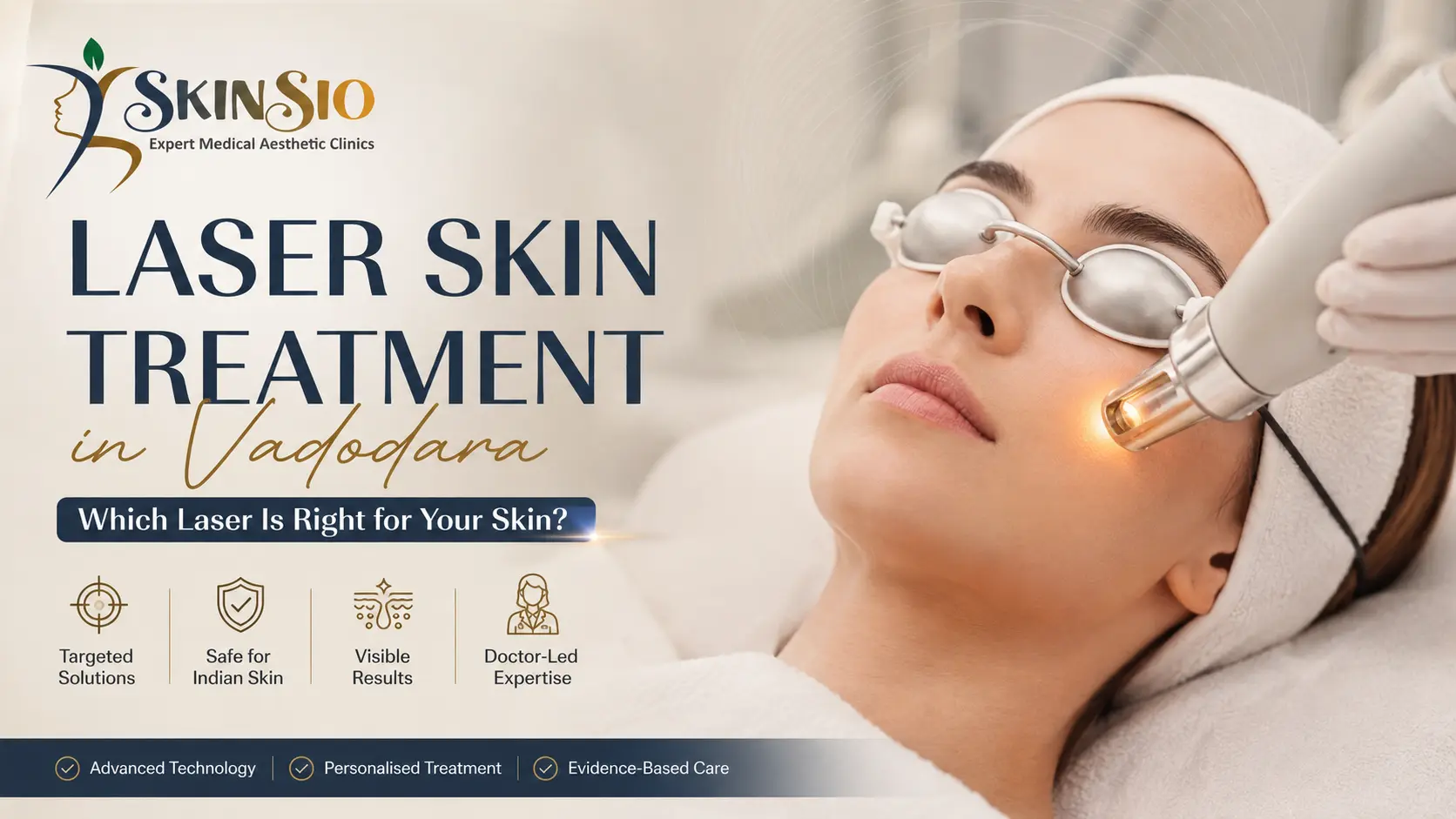
Laser Skin Treatment in Vadodara: Why the Right Laser Matters More Than the Marketing
"Laser treatment" is often talked about as if it's a single procedure — but it isn't. It's an umbrella term covering a spectrum of technologies, each built around a different principle: selective photothermolysis, where a targeted wavelength of light is absorbed by a specific chromophore in the skin (melanin, water, or haemoglobin), converting to heat and triggering either destruction of unwanted tissue or a controlled healing response that rebuilds collagen. Because different lasers penetrate to different depths and target different chromophores, the "best" laser genuinely depends on what you're treating and what skin tone you have.
This distinction matters enormously in Vadodara, where the overwhelming majority of patients fall into Fitzpatrick skin types III–V — skin with more baseline melanin than the lighter skin types most laser research and marketing originates from. At SkinSio Clinics, Manjalpur, every laser treatment starts with a proper skin assessment specifically because the wrong laser, or the right laser at the wrong setting, can worsen pigmentation rather than improve it on Indian skin.
What Skin Concerns Can Lasers Actually Treat?
Lasers and IPL (Intense Pulsed Light) address a wide range of skin concerns, each requiring a different device or wavelength:
| Concern | Typical Technology | Treatment Goal |
|---|---|---|
| Acne scars | Fractional laser (CO₂/Erbium), RF microneedling | Collagen remodelling, improved texture |
| Pigmentation (sunspots, melasma, PIH) | Q-switched/picosecond laser, IPL | Break up excess melanin |
| Fine lines & early ageing | Non-ablative or fractional laser | Collagen stimulation, smoothing |
| Uneven texture, enlarged pores | Fractional laser, microneedling | Smoother, tighter-looking skin |
| Active acne | Carbon laser, blue light, vascular laser | Reduce inflammation and bacteria |
| Unwanted hair | Diode or long-pulse Nd:YAG laser | Long-term hair reduction |
| Tattoos | Q-switched or picosecond laser | Break up tattoo pigment for clearance |
| Vascular lesions, redness | Pulsed-dye or long-pulse Nd:YAG | Fade visible blood vessels |
Laser vs IPL: They Are Not the Same Thing
A common point of confusion: laser and IPL are frequently marketed interchangeably, but they work differently. Lasers emit a single, coherent wavelength of light, allowing precise, concentrated energy delivery to a specific target. IPL devices emit broad-spectrum, polychromatic light filtered across a wider range — useful for treating diffuse pigment or redness, but generally requiring more sessions for milder, less predictable results per session. The right choice depends on your skin tone, the target chromophore (melanin, blood, or water), hair colour, treatment area, downtime tolerance, and your individual risk of post-inflammatory hyperpigmentation (PIH).
Which Laser Is Best for Indian Skin?
Indian skin tones (Fitzpatrick III–V) carry more epidermal melanin than the lighter skin types most consumer laser marketing is built around. This means laser settings must be chosen with real care — too much energy, or the wrong wavelength, increases the risk of burns, prolonged redness, and post-inflammatory hyperpigmentation.
Shorter-wavelength lasers like Alexandrite (755 nm) carry a comparatively higher PIH risk in darker skin, while longer wavelengths — Diode (810 nm) and long-pulse Nd:YAG (1064 nm) — penetrate deeper with a meaningfully safer profile for Fitzpatrick III–V patients. This is consistent with a broader body of clinical evidence on laser hair removal in Asian skin, which points to Nd:YAG and diode lasers as the preferred choice for their superior safety margin. In practice, this means Vadodara clinics treating local patients should default to longer wavelengths, robust cooling, conservative fluences, and pre-treatment patch tests rather than one-setting-fits-all protocols.
Laser Treatment for Pigmentation in Vadodara
"Pigmentation" is not one diagnosis — it covers melasma, post-inflammatory hyperpigmentation (PIH), solar lentigines (sunspots), freckles, and generalised tanning, and treatment needs to match the specific diagnosis rather than a generic "brightening" protocol. This is a point we've covered in detail in our complete pigmentation treatment guide.
Importantly, lasers themselves can worsen pigment if misapplied. Aggressive, ablative energy-based lasers (CO₂, Erbium) are generally contraindicated for melasma and PIH, since they frequently trigger rebound pigmentation or worsening in these conditions. Safer, evidence-aligned approaches for pigment-prone Indian skin use gentler devices — low-fluence Nd:YAG toning, fractional lasers, or IPL used selectively — always combined with strict daily sun protection and, where indicated, topical lightening therapy, rather than relying on laser alone as a "bleaching" shortcut.
Laser Treatment for Acne Scars
Acne scarring is best addressed with a multimodal approach, and lasers are one genuinely effective tool within it — particularly for atrophic (depressed) scars. Fractional lasers (CO₂ or Erbium) create controlled microscopic injury zones that stimulate new collagen and remodel scarred tissue, and this is well supported in the clinical literature specifically for atrophic acne scarring. In practice, fractional laser is frequently combined with microneedling, subcision, PRP, or TCA CROSS depending on scar type — our dedicated acne scar treatment guide breaks down exactly which combination suits which scar pattern.
Laser Hair Reduction
Laser hair removal (LHR) on Indian skin is most commonly performed using diode (810 nm) or long-pulse Nd:YAG (1064 nm) lasers. Because hair grows in cycles, multiple sessions — typically 6–8 or more — are required to catch follicles across different growth phases. Clinical data on Fitzpatrick III–V skin supports both effectiveness and safety with the correct laser choice, with Nd:YAG and diode devices specifically favoured for their safety profile over shorter-wavelength alternatives like Alexandrite. For a full breakdown of technology comparisons, session protocols, and Vadodara pricing, see our dedicated laser hair removal guide.
How Many Laser Sessions Are Needed?
There's no universal answer — it depends on the condition, the device, and your individual skin response. As a general guide: acne scars or pigmentation typically need 3–6 sessions, spaced 3–6 weeks apart, before substantial improvement is visible. Laser hair removal usually needs more sessions given the hair growth cycle. Most patients require multiple sessions to reach their best result — your SkinSio provider will set a realistic session estimate specific to your skin and chosen protocol at consultation, rather than a generic number.
Does Laser Treatment Hurt?
Pain levels vary by treatment type. Most modern lasers incorporate cooling — a chilled tip, gel, or cold air — alongside brief pulse durations specifically to reduce discomfort. Topical numbing cream may be used for more intensive ablative resurfacing. Most patients describe each pulse as a quick warming or snapping sensation that passes almost immediately. Mild redness and swelling immediately afterward are common and typically settle within hours to a few days, depending on how aggressive the treatment was. Genuine severe pain, blistering, or prolonged burning should not occur with properly calibrated equipment and settings.
Laser Treatment Downtime: What to Expect
| Treatment | Typical Downtime |
|---|---|
| Gentle non-ablative lasers (light IPL, Nd:YAG toning) | Minimal — minutes to hours of brief redness |
| Carbon laser facial (Hollywood peel) | Essentially none — "zero downtime" |
| Fractional non-ablative lasers | Mild — 1–3 days of light redness or peeling |
| RF microneedling | Mild — 1–2 days of tiny dot-like redness |
| Fractional ablative lasers (CO₂, Erbium) | Significant — approximately 5–7 days of peeling/redness |
Actual recovery time depends on energy settings, treated area, and individual healing capacity. Ablative lasers specifically can require around a week of visible recovery and up to two weeks of residual pinkness — your doctor should walk you through exactly what to expect for your specific procedure before treatment begins.
How Much Does Laser Skin Treatment Cost in Vadodara?
Pricing varies meaningfully by indication, treatment area, and number of sessions required. As a general Vadodara market guide: Carbon laser facial sessions typically run ₹3,000–5,000; acne-scar or pigmentation laser sessions run roughly ₹4,000–10,000 depending on extent and device used; chemical peels (often used alongside laser) run approximately ₹1,500–4,000; and PRP, frequently paired with laser for scar or pigment work, runs around ₹5,000–8,000 per session. Clinics commonly offer package pricing for multi-session courses. Always clarify with any clinic whether a quoted price is per area, per session, and whether it includes follow-up visits.
Pricing at SkinSio Clinics is confirmed with a personalised, itemised quote after your consultation. Call or WhatsApp +91 93220 22392 for current rates.
How to Choose a Laser Clinic in Vadodara
- Who is assessing you? Confirm a qualified doctor or experienced clinical specialist evaluates your skin — not a sales representative.
- Is your diagnosis clear? The clinic should specifically name what you have — melasma vs. sun spots vs. PIH — before recommending a laser.
- Which device is being used, and why? Ask for the specific laser brand and wavelength, and why it's appropriate for your skin type.
- Are settings personalised? Good clinics adjust energy, pulse duration and cooling to your skin tone and specific condition — be wary of fixed, "one setting for everyone" protocols.
- Is a test patch offered? Especially important for darker skin or stronger lasers; a small test spot reveals how your skin reacts before full treatment.
- What are the risks specific to your skin? Ask directly about PIH, burn risk, and how the clinic plans to minimise them for your tone.
- How many sessions are realistically expected? A credible clinic gives a specific estimate — "you'll likely need 4–5 sessions" — rather than vague promises.
- What aftercare is required? Sunscreen and gentle skincare are essential post-laser; the clinic should provide clear, written instructions.
At SkinSio Clinics, Manjalpur, Vadodara, every laser consultation is doctor-led, devices are chosen specifically for Fitzpatrick III–V skin, and settings are individually calibrated rather than templated. We prioritise accurate diagnosis, test patches where appropriate, and thorough aftercare guidance over quick "laser whitening" promises — the same transparent, evidence-first approach we take across our carbon laser facial, laser hair removal, and scar and stretch mark treatment guides.
Book a Laser Skin Treatment Consultation in Vadodara
Whether you're dealing with pigmentation, acne scars, unwanted hair, or early signs of ageing, the right laser starts with the right diagnosis. At SkinSio Clinics, Manjalpur, Vadodara, our doctors assess your specific concern and skin type before recommending any device, using US FDA-approved lasers calibrated for Indian skin throughout. Call or WhatsApp +91 93220 22392, or visit us at A/203, The Atlantic, Makarpura Road, Manjalpur to get started.
Frequently Asked Questions
Which laser is best for pigmentation on Indian skin?
For Indian skin (Fitzpatrick III–V), low-fluence Q-switched Nd:YAG (1064 nm) 'laser toning' and picosecond lasers are generally preferred because their longer wavelength and shorter pulse duration reduce heat spread and lower the risk of post-inflammatory hyperpigmentation. Aggressive IPL and ablative devices carry meaningfully higher risk on darker skin and are used far more selectively.
Is laser treatment safe for dark or tanned skin?
Yes, when the laser type and settings are correctly matched to your skin tone. At SkinSio Clinics, every new patient undergoes a Fitzpatrick skin typing assessment and, where appropriate, a test patch before full treatment. Longer-wavelength lasers such as Nd:YAG and diode are specifically chosen for their safety profile on Fitzpatrick III–V skin.
How many laser sessions will I need?
This depends on the concern. Acne scars or pigmentation typically need 3–6 sessions spaced 3–6 weeks apart. Laser hair reduction needs 6–8 sessions spaced 4–6 weeks apart. Tattoo removal and vascular lesions vary widely by size and depth. Your SkinSio dermatologist will give you a realistic, personalised session estimate at consultation.
Does laser treatment hurt, and is there downtime?
Most modern lasers use built-in cooling and brief pulses, so discomfort is generally described as a quick warm snap rather than significant pain. Downtime varies by device: non-ablative lasers and laser toning have little to no downtime, while ablative fractional lasers (CO₂, Erbium) can require 5–7 days of redness and peeling.
Can lasers treat melasma?
Melasma requires a cautious approach because energy-based ablative lasers can worsen it. SkinSio Clinics uses gentler modalities — low-fluence Nd:YAG toning, non-ablative or fractional lasers — combined with topical therapy and strict sun protection, rather than aggressive resurfacing, which is contraindicated for most melasma patients.
What is the difference between IPL and laser?
IPL (Intense Pulsed Light) emits broad-spectrum, unfocused light and typically needs more sessions for milder results. True lasers emit a single, coherent wavelength, allowing more precise, concentrated energy delivery. For Indian skin specifically, calibrated lasers such as Nd:YAG or diode are generally considered safer and more effective than IPL.
How much does laser skin treatment cost in Vadodara?
Pricing varies by treatment: Carbon laser facial sessions typically run ₹3,000–5,000, pigmentation or acne-scar laser ₹4,000–10,000 per session depending on area and device, and laser hair reduction packages vary by body area. SkinSio Clinics provides a personalised, itemised quote after your consultation. Call +91 93220 22392 for current rates.
How do I choose the right laser clinic in Vadodara?
Confirm a qualified doctor is assessing your skin, ask which specific laser (brand and wavelength) will be used and why it's appropriate for your skin type, check whether a test patch is offered, and ask for a clear session estimate and pricing before you commit. A clinic that can't answer these specifically is one to be cautious of.