
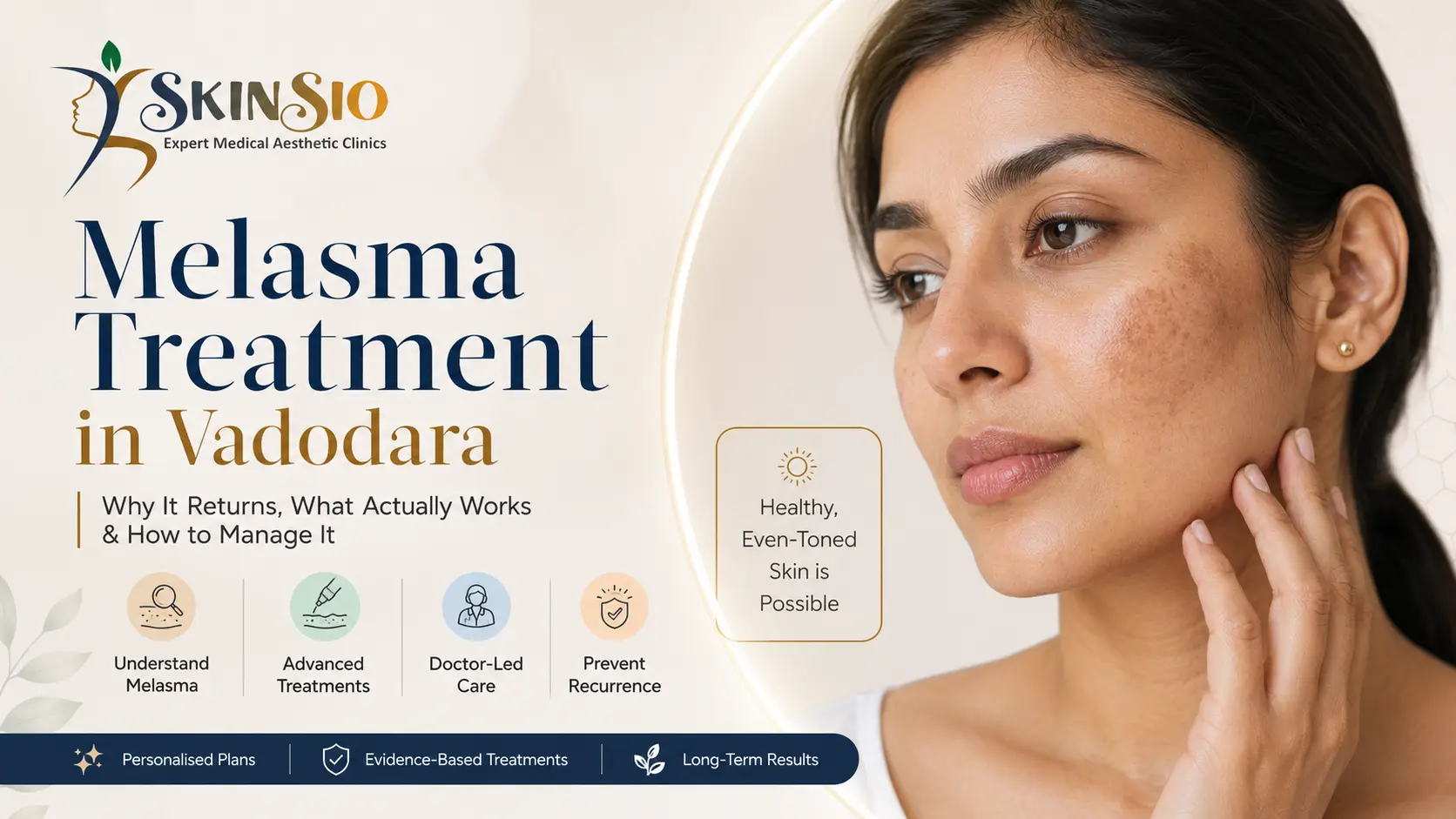
Melasma Treatment in Vadodara: Why It Returns, What Actually Works & How to Manage It
You treat the pigmentation. It improves. Then a few months later, the brown patches slowly return.
If you've experienced this, you are not alone. Melasma is one of the more persistent forms of facial pigmentation, and treating it successfully involves more than simply trying to lighten the skin. In Vadodara, regular sun exposure, heat and visible-light exposure can make pigment management particularly challenging. The goal of treatment is not simply to make melasma lighter temporarily, but to control pigment production, address contributing factors, and reduce the likelihood of recurrence.
This guide explains how melasma is diagnosed, which treatments may be considered, why melasma often returns, and how a personalised treatment plan at SkinSio Clinics, Vadodara can help.
What Is Melasma?
Melasma is a form of acquired hyperpigmentation, typically symmetrical, affecting sun-exposed areas of the face — most commonly the cheeks, forehead, upper lip, and nose or chin. It appears as brown to grey-brown patches and is not simply "tanning" — melasma involves a distinct, more persistent pattern of overactive pigment production that behaves differently from ordinary sun tan and often does not fade on its own the way a tan would.
What Does Melasma Look Like?
Clinicians generally describe three common distribution patterns:
- Centrofacial — forehead, cheeks, nose, upper lip and chin (the most common pattern)
- Malar — concentrated on the cheeks and nose
- Mandibular — along the jawline
Clinical appearance alone isn't always enough to confirm the diagnosis — other causes of facial pigmentation need to be considered and ruled out, which is why a proper in-person assessment matters before starting any treatment.
What Causes Melasma?
UV Radiation
Ultraviolet exposure is one of the best-established triggers, stimulating melanocytes to increase melanin production.
Visible Light
Visible light can also contribute to pigmentation in some people, particularly those with darker skin types — which is one reason plain SPF alone isn't always sufficient for melasma-prone patients, and why iron-oxide-containing sunscreens are often recommended.
Hormonal Influences
Pregnancy, oral contraceptives, and other hormonal changes are commonly associated with melasma. That said, not every case of melasma is hormonally driven — many patients develop it independent of any hormonal trigger.
Heat
Prolonged heat exposure — outdoor heat, hot environments, and Vadodara's warm climate for much of the year — is increasingly recognised as a contributing factor alongside UV and visible light, though heat and climate alone do not cause melasma on their own.
Genetic Susceptibility
A family history of melasma is common, suggesting a genetic predisposition that interacts with the environmental triggers above.
Why Is Melasma So Commonly Recurrent?
This is one of the most important things to understand about melasma. It isn't simply a layer of pigment sitting on top of otherwise normal skin — it involves active melanocytes and a complex interaction between UV exposure, visible light, hormonal influences, inflammation, vascular factors, skin barrier function, and genetic susceptibility.
Because of this, removing existing pigment does not necessarily remove the underlying tendency to produce pigment. The melanocytes that caused the original patches remain primed to reactivate whenever triggered again — by sun exposure, heat, hormonal shifts, or skin inflammation — which is exactly why melasma has a reputation for returning even after a course of treatment appeared to work.
Is Melasma Permanently Curable?
Melasma can often be significantly improved and controlled, but recurrence is common, and it should not be promised as a one-time permanent cure. The more accurate and medically honest framing is: control → improvement → maintenance → recurrence prevention. Patients who go in expecting a single treatment to "fix" melasma for good are often disappointed — those who understand it as an ongoing, manageable condition tend to get much better long-term results.
How Is Melasma Diagnosed?
A proper melasma assessment goes well beyond simply looking at a dark patch and reaching for a laser. At SkinSio Clinics, diagnosis involves a clinical examination alongside a detailed history covering:
- Pregnancy, hormonal status, or hormonal medications
- Current medications and skincare products in use
- Previous treatments tried and how the skin responded
- Typical sun exposure and outdoor habits
- Distribution pattern and skin type
This assessment also considers differential diagnoses — conditions that can look similar to melasma but need different treatment, including post-inflammatory hyperpigmentation, lentigines, freckles, drug-induced pigmentation, and other facial pigmentary disorders. Getting this distinction right at the outset is what separates a treatment plan that actually works from one that wastes months on the wrong approach.
Melasma Treatment in Vadodara: What Options Are Available?
There is no single best treatment for every person with melasma. Instead, treatment is typically layered, starting with the foundation and adding procedures where appropriate.
1. Sun & Visible-Light Protection
This comes before any laser or peel, not after. It includes broad-spectrum sunscreen with adequate SPF, frequent reapplication, hats and shade where practical, and — importantly for melasma specifically — tinted sunscreens containing iron oxides, which provide protection against visible light in a way that standard UV-only sunscreens do not.
2. Prescription Topical Treatments
Possible medical options include hydroquinone, tretinoin, azelaic acid, and combination therapy, along with other depigmenting agents depending on clinical assessment. These are prescription-grade treatments that should be used under appropriate medical supervision — not self-prescribed or bought over the counter.
3. Chemical Peels for Melasma
Peels such as glycolic acid, lactic acid, salicylic acid in selected contexts, and combination peels can help — but more aggressive is not necessarily better. Improperly selected or overly strong peels can cause irritation and trigger post-inflammatory hyperpigmentation, which is particularly relevant for Indian skin. Peel strength at SkinSio Clinics is chosen conservatively and adjusted to how your skin responds.
4. Laser & Light-Based Treatments for Melasma
Lasers may be considered in selected patients, but response is variable, recurrence is common, and inappropriate settings can worsen pigmentation. Treatment selection is based on skin type and melasma characteristics — never a blanket claim that any single laser "permanently removes" melasma, since that isn't medically accurate. Technologies used cautiously and selectively may include Q-switched Nd:YAG, fractional laser approaches, or selected IPL/light-based treatments, depending on the individual case.
5. Tranexamic Acid for Melasma
Tranexamic acid — used topically or in selected cases orally — has a growing evidence base for melasma. Patient selection matters, as does screening for contraindications and appropriate medical assessment beforehand. This is not a treatment for self-dosing; it requires proper medical evaluation, which is standard practice at SkinSio Clinics for any patient being considered for this option.
6. Combination Treatment
This is often the most effective approach. Rather than relying on one laser session to "solve" melasma, a clinician may combine photoprotection, topical therapy, selected procedures, and ongoing maintenance — for example, topical therapy first, followed by a controlled procedure, followed by a structured maintenance plan, rather than a single laser session presented as a complete fix.
Which Treatment Is Best for Melasma?
Rather than naming one "winner," it's more useful to understand where each approach typically fits:
| Treatment | Where It May Fit | Important Consideration |
|---|---|---|
| Sunscreen / Photoprotection | Almost every plan | Essential for recurrence prevention |
| Topical Therapy | First-line / maintenance | Requires appropriate selection |
| Chemical Peels | Selected cases | Irritation can worsen pigmentation |
| Laser / Light | Selected resistant cases | Settings and skin type matter greatly |
| Tranexamic Acid | Selected patients | Medical screening required |
| Combination Therapy | Many patients | Individualised planning |
Can Laser Make Melasma Worse?
Yes — this is one of the most important things patients considering laser treatment should understand. Any procedure that causes excessive inflammation or injury can potentially worsen pigmentation in susceptible skin. This can happen due to:
- The wrong indication for laser in the first place
- Excessive energy or aggressive settings
- An inappropriate wavelength for the skin type
- Inadequate photoprotection after the procedure
- Poor aftercare generally
This is precisely where clinics simply advertising "laser for pigmentation" without proper skin assessment can do genuine harm. At SkinSio Clinics, laser is used selectively, cautiously, and only when it's the appropriate tool for your specific presentation — not as a default first response to every pigmentation complaint.
How Many Sessions Are Needed?
There's no fixed number that applies to everyone. It depends on severity, depth of pigment, skin type, the treatment modality chosen, any previous treatment history, how your skin responds along the way, and the maintenance plan that follows. Realistic expectations matter here — anyone promising a specific low session count without first assessing your skin isn't giving you an honest answer.
How Long Does Melasma Treatment Take?
Improvement may take weeks to months. Melasma is generally best understood as a management process, not an instant cosmetic procedure. Patients who approach it with this mindset — building consistent photoprotection and treatment into a routine rather than expecting a quick fix — tend to see steadier, more lasting improvement.
Melasma Treatment Cost in Vadodara
The cost of melasma treatment in Vadodara varies depending on whether treatment involves topical medication, chemical peels, laser or light-based procedures, tranexamic acid, combination therapy, or ongoing maintenance treatment. At SkinSio Clinics, actual SkinSio pricing is provided only after a consultation and skin assessment, since the right combination — and therefore the cost — depends entirely on your individual diagnosis and treatment plan. Call or WhatsApp +91 93220 22392 for current rates.
Why Melasma Treatment Should Be Personalised for Indian Skin
Skin with higher melanin content can have a greater risk of post-inflammatory hyperpigmentation after certain procedures, which is exactly why appropriate device selection and conservative treatment settings matter so much for Indian patients. This isn't about Indian skin being inherently "difficult" — it's about respecting how melanin-rich skin responds differently to heat and injury, and calibrating treatment accordingly rather than applying settings designed for lighter skin types.
In practice, this means: gentler peel concentrations, more conservative laser fluences, longer intervals between sessions where needed, and closer monitoring for early signs of irritation — all standard practice for pigmentation-prone patients at SkinSio Clinics.
Why Choose SkinSio Clinics for Melasma Treatment in Vadodara?
At SkinSio Clinics, treatment starts with assessment rather than selecting a procedure first. Our approach includes:
- Thorough diagnosis before any treatment recommendation
- A personalised plan built around your specific pattern and skin type
- A conservative, evidence-based approach rather than aggressive one-size-fits-all protocols
- Appropriate combination treatments, sequenced correctly
- Realistic expectations set clearly from the first visit
- Structured follow-up and maintenance planning to reduce recurrence
Melasma Prevention & Daily Management
Consistent daily habits meaningfully reduce recurrence risk. As a general framework — always tailored to your skin by your clinician:
Morning: gentle cleanser, any prescribed antioxidant or active if appropriate, moisturiser, and broad-spectrum sunscreen — ideally a tinted, visible-light-protective formula for melasma-prone skin.
During the day: reapply sunscreen, seek shade where practical, use a hat, and avoid unnecessary direct sun exposure, particularly during peak hours.
Evening: any prescribed topical treatment, moisturiser, and avoiding excessive exfoliation, which can trigger irritation-driven pigmentation.
Exact products should always be selected according to your skin type and your clinician's advice rather than generic recommendations.
Common Mistakes That Make Melasma Worse
- Using multiple fairness or bleaching products at once — layering unrelated actives increases irritation risk without improving results
- Aggressive scrubbing — mechanical irritation can worsen pigmentation rather than exfoliate it away
- Changing treatments every 2 weeks — melasma treatments need weeks to months to show effect; frequent switching prevents any of them from working
- Using unprescribed steroid-containing creams — these can temporarily lighten skin but often worsen pigmentation and cause other complications with continued use
- Doing repeated aggressive peels — over-treatment triggers the same inflammation-driven pigmentation the peel was meant to fix
- Getting laser treatment without proper assessment — as covered above, the wrong laser or settings can actively worsen melasma
- Stopping sunscreen once pigmentation improves — this is one of the most common causes of relapse
- Expecting permanent results after one procedure — melasma requires ongoing management, not a single fix
Melasma vs Other Types of Facial Pigmentation
Because several pigmentation conditions can look similar, an accurate diagnosis matters more than the treatment itself:
| Condition | Typical Appearance | Common Context |
|---|---|---|
| Melasma | Symmetrical brown/grey patches | Hormonal, UV, visible light |
| PIH | Dark marks after inflammation | Acne, injury, or procedure-related |
| Solar Lentigines | Discrete brown spots | Chronic cumulative sun exposure |
| Freckles | Small pigmented macules | Genetic, UV-related |
| Tanning | More diffuse, even darkening | Recent UV exposure |
For a broader look at how Vadodara's climate drives pigmentation and early skin ageing generally, see our companion guide on pigmentation and skin ageing in Vadodara. If post-acne dark marks are part of your concern specifically, our acne treatment guide and acne scar treatment guide cover that distinction in more depth. For a full comparison of evidence-based pigmentation treatments across all types, our complete pigmentation treatment guide is a useful companion read to this one.
Frequently Asked Questions
What is the best treatment for melasma?
There is no single best treatment for every patient — melasma responds best to a combination approach built around daily photoprotection, appropriate topical therapy, and selected procedures such as chemical peels, laser, or tranexamic acid, chosen based on your specific pigment depth and skin type. At SkinSio Clinics, this combination is personalised after a proper diagnostic assessment rather than applied as a fixed package.
Can melasma be permanently cured?
Melasma can often be significantly improved and controlled, but it cannot be guaranteed to be permanently cured. Recurrence is common, particularly with sun exposure, heat, or hormonal changes. The realistic goal is control, improvement, and long-term maintenance rather than a one-time permanent fix — and this is something we're upfront about at consultation.
Why does my melasma keep coming back?
Melasma involves overactive melanocytes influenced by a mix of UV and visible light exposure, hormonal factors, heat, inflammation and genetic susceptibility. Treating existing pigment doesn't switch off this underlying tendency, so without consistent sun protection and maintenance, pigment-producing cells can reactivate and pigmentation can return.
Can laser treatment remove melasma?
Laser may be considered in selected patients as part of a broader plan, but response varies and recurrence is common. Inappropriate laser settings can actually worsen melasma, particularly on Indian skin. At SkinSio Clinics, laser is used cautiously, calibrated to skin type, and is never presented as a standalone permanent fix.
Can chemical peels help melasma?
Selected chemical peels — glycolic, lactic, or combination peels — can help improve melasma in appropriate patients as part of a broader plan. However, more aggressive peels are not necessarily better and can cause irritation that worsens pigmentation, especially on Indian skin, so peel strength is chosen carefully.
How long does melasma treatment take?
Improvement typically takes weeks to months rather than days. Melasma is best understood as an ongoing management process rather than an instant cosmetic fix, and most patients see gradual improvement over a series of sessions combined with consistent home care.
How much does melasma treatment cost in Vadodara?
Cost varies depending on whether your plan involves topical medication, chemical peels, laser or light-based procedures, tranexamic acid, or a combination approach. SkinSio Clinics provides a personalised, itemised quote after your consultation and skin assessment. Call +91 93220 22392 for current rates.
Can sunscreen prevent melasma from returning?
Daily broad-spectrum sun protection is one of the most important factors in preventing melasma recurrence. Since visible light can also contribute to pigmentation in darker skin types, tinted sunscreens containing iron oxides are often recommended alongside standard SPF for patients prone to melasma.
Can melasma get worse after a laser or peel?
Yes, this can happen if the treatment causes excessive inflammation or injury in susceptible skin — for example, from the wrong laser wavelength, excessive energy settings, an overly aggressive peel, or inadequate sun protection afterward. This is why treatment selection and settings are calibrated carefully for skin type at SkinSio Clinics.
When should I see a doctor for facial pigmentation?
It's worth seeing a doctor if you notice new or spreading dark patches, pigmentation that doesn't improve with sunscreen and basic skincare, or if you're unsure whether what you have is melasma, post-inflammatory hyperpigmentation, or another condition — since the diagnosis genuinely changes what treatment will work.