
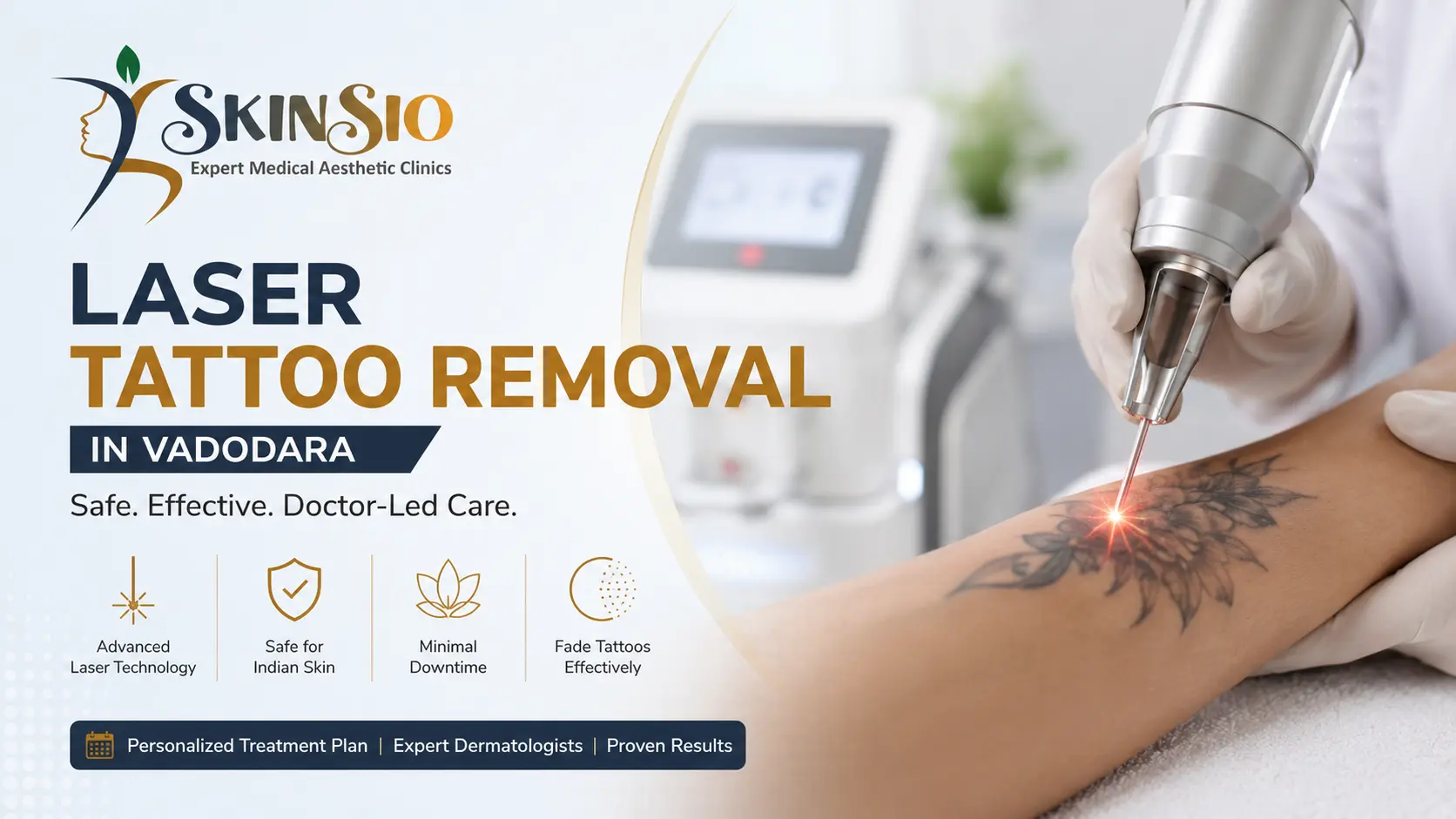
Tattoo Removal in Vadodara: What Actually Works
Unwanted tattoos are increasingly common, and more people across Vadodara are seeking professional removal rather than living with a design that no longer fits their life. Today's most effective option is laser tattoo removal. Modern lasers can fade or largely eliminate a tattoo's pigment, but it typically takes multiple sessions, and complete clearing is never guaranteed. The outcome depends on several genuine variables: ink colour, depth and density, tattoo age, your skin type, and the specific laser and settings used.
Indian skin tones carry more baseline melanin, so the laser specialist must choose the right wavelength and conservative settings to avoid burns or pigment changes. In practice, patients can expect noticeable fading over weeks and months, but a faint remnant sometimes remains even after a full course. Setting realistic expectations from the very first consultation is essential — which is exactly the approach we take at SkinSio Clinics, Manjalpur, Vadodara.
What Is Tattoo Removal, and How Does It Work?
Tattoos consist of ink pigment particles lodged in the dermis — the deeper layer of skin. Removing a tattoo means breaking up and clearing those pigment particles. Laser removal applies very short, intense pulses of light that the pigment absorbs, heating it rapidly and causing it to fragment into tiny particles. Immediately after a laser pulse, the treated area often turns briefly white — a phenomenon called "frosting," caused by tiny vapour bubbles and pigment fragmentation beneath the skin.
After that, your body's own immune system takes over. Macrophages — the body's cleanup cells — gradually engulf the fragmented pigment and carry it away via the lymphatic system over the following weeks. This is why tattoo fading is always gradual rather than instant: each session breaks down more ink, and your body clears a portion of it before the next visit. This is also exactly why topical creams cannot work — they can only affect the very top skin layer and have no way of reaching ink sitting in the dermis.
This laser-based approach — known technically as selective photothermolysis — has become the standard in dermatology precisely because it targets ink with minimal injury to surrounding healthy skin, unlike older methods such as surgical excision or dermabrasion.
Laser vs. Surgical Excision vs. Dermabrasion
| Method | How It Works | Best For | Downside |
|---|---|---|---|
| Laser Removal (Q-switched/Pico) | Light energy fragments ink; body clears it naturally | Most tattoos, any size, most colours | Requires multiple sessions over months |
| Surgical Excision | Tattooed skin is physically cut out and stitched | Very small tattoos only | Leaves a visible linear scar |
| Dermabrasion | Mechanical sanding of the skin surface | Rarely used today | Painful, raw healing, inconsistent results |
In practice, laser removal is preferred for the overwhelming majority of unwanted tattoos because it can treat large, coloured, and complex designs without surgically removing skin. Surgical excision still has a narrow, specific role for tiny tattoos where a linear scar is preferable to the tattoo itself, and dermabrasion has been largely superseded by safer, more predictable laser technology.
Which Laser Is Used for Tattoo Removal?
Different lasers target ink based on wavelength and pulse duration. The classic devices are "Q-switched" lasers, delivering nanosecond pulses:
- Nd:YAG (1064 nm and 532 nm) — The 1064 nm infrared wavelength penetrates deepest and is absorbed well by black and dark blue ink; it's also the safer choice for darker skin since it's absorbed less by natural melanin. The frequency-doubled 532 nm output is the standard choice for red ink.
- Alexandrite (755 nm) — Absorbed by black, blue and green inks; shallower penetration than Nd:YAG, useful for certain stubborn colours.
- Ruby laser (694 nm) — An older Q-switched option for black, blue and green ink, now largely replaced by Nd:YAG and Alexandrite in modern practice.
- Picosecond lasers — Newer devices delivering pulses roughly 1,000 times shorter than nanosecond lasers, creating a stronger photoacoustic shockwave that shatters pigment more finely. Clinical research has found picosecond Nd:YAG can clear black tattoos more effectively in the same number of sessions compared to traditional Q-switched devices — often reserved for stubborn colours or when faster progress is a priority.
No single laser removes every colour equally well. Black ink is the most responsive overall since it absorbs all wavelengths — genuinely "the easiest to remove." For darker or more pigmented skin, specialists typically favour the 1064 nm Nd:YAG specifically because it penetrates deeply with far less melanin absorption than shorter wavelengths.
Can All Tattoo Colours Be Removed?
| Tattoo Colour | Removal Consideration |
|---|---|
| Black | Best response — absorbs all laser wavelengths, typically fades fastest |
| Dark Blue | Good response, especially to 1064 nm and Alexandrite lasers |
| Green | More resistant — often needs stronger lasers and more sessions |
| Red | Responds well when treated with the correct 532 nm wavelength |
| Yellow / Orange | Very challenging — absorbs poorly, may only lighten slightly |
| White | Unpredictable — can occasionally darken or yellow under laser |
| Multicoloured | Complex — each colour needs separate targeting, longer sessions |
These are general trends, not guarantees — actual results depend on the specific ink formulation and depth used by your original tattoo artist. This is why an honest, in-person assessment at SkinSio Clinics always comes before any commitment to a treatment plan or session count.
How Many Sessions Does Tattoo Removal Take?
There is no fixed, one-size-fits-all number — and any clinic promising a specific low session count before even seeing your tattoo isn't giving you an honest answer. Most patients need roughly 6 to 12 sessions, sometimes more, spaced several weeks apart. Simple amateur tattoos with thin black lines may clear in fewer sessions; dense, multi-coloured, or cover-up tattoos often need considerably more.
Factors that genuinely affect your session count:
- Ink colour — black and dark blue clear fastest; greens, yellows and teals take considerably longer
- Ink density and depth — heavily inked or deeply placed tattoos hold more pigment and need more sessions
- Size — larger tattoos mean more area to cover, though this affects session length more than count
- Age of the tattoo — older tattoos sometimes fade slightly faster, but colour and density still matter more than age alone
- Cover-ups — multiple layers of ink genuinely mean more total treatment
- Previous removal attempts — prior laser or chemical treatments can sometimes complicate further removal
How Long Between Sessions?
Sessions are typically spaced 4–8 weeks apart, giving the skin time to heal and the immune system time to clear fragmented pigment. Treating the same area too soon doesn't speed up results — the ink is often still compacted and the skin hasn't fully recovered — and can actually increase the risk of complications. Patience through the spacing is part of what makes the process safe.
Does Laser Tattoo Removal Hurt?
It can be uncomfortable, but it's generally manageable. Most patients describe each pulse as a quick sting, often compared to a rubber band snapping against the skin, followed by a warm, sunburn-like sensation for a day or two afterward. Discomfort varies by location — bonier areas like the shin or ankle tend to sting more than fleshier areas like the thigh — and by individual pain tolerance.
Cooling methods meaningfully reduce discomfort: cold air devices, ice packs, or gel-soaked pads during and immediately after treatment. Topical numbing cream can also be used for larger or more sensitive areas. Most patients report the removal process is considerably less painful than getting the original tattoo, and any clinic promising a completely painless experience isn't being fully accurate.
Is Laser Tattoo Removal Safe for Indian Skin?
Indian skin tones — typically Fitzpatrick III–V — carry more natural melanin, which means a genuinely higher risk of pigmentary side effects if lasers aren't chosen and calibrated carefully. With proper laser selection and conservative settings, however, tattoo removal is both safe and effective for darker skin.
The key is wavelength selection. Longer wavelengths penetrate deeper while being absorbed far less by natural skin melanin. The 1064 nm Nd:YAG laser is generally considered the workhorse for pigmented skin, since it's preferentially absorbed by black ink and much less by surrounding skin pigment — meaningfully reducing burn and post-inflammatory hyperpigmentation risk. Shorter wavelengths carry comparatively more risk of heating epidermal melanin on darker skin.
Post-inflammatory pigmentation changes — both temporary darkening and lightening — are a recognised possibility in darker skin after laser procedures. This is why clinics treating Indian skin should always start cautiously, often with a conservative test spot, and adjust energy settings based on how the skin actually responds, alongside proper cooling and strict sun avoidance during healing. When performed correctly, the risk of serious burns or permanent scarring stays low.
Can Tattoo Removal Cause Scarring or Pigmentation Changes?
Because removal necessarily causes some controlled injury to the skin, temporary reactions are expected — redness, swelling, and occasionally mild blistering or scabbing that typically heals within one to two weeks with good aftercare. Permanent damage is uncommon when the procedure is done properly.
Pigment changes are also possible: treated areas can temporarily lighten (hypopigmentation) or darken (hyperpigmentation), with darker skin somewhat more prone to these shifts. Most pigment changes fade gradually over months; true permanent hypopigmentation is rare but not impossible. Genuine scarring is also uncommon with modern lasers used correctly — published reviews report scarring rates well under 5% with appropriate technique.
What minimises these risks:
- Choosing the appropriate wavelength and conservative energy for your specific skin tone
- Cooling the skin throughout treatment
- Spacing sessions to allow full healing between visits (generally 4+ weeks)
- Following aftercare instructions strictly — cleanliness, sun avoidance, and not disturbing scabs or blisters
- Never overtreating a single area in one session, even if it means the tattoo takes a session or two longer to clear
How Much Does Tattoo Removal Cost in Vadodara?
Pricing varies meaningfully by tattoo size, ink colour, and density — and is always charged per session, not as a single flat fee. In Vadodara, per-session pricing typically falls somewhere in the range of ₹2,000–8,000, with smaller, simpler black tattoos toward the lower end and larger, multi-coloured designs toward the upper end.
Because a full course commonly requires 6–12 sessions or more, total cost for a complete removal often lands somewhere between ₹20,000 and ₹50,000, sometimes more for dense or heavily layered tattoos. Two tattoos of identical size can cost very differently to remove — a small, shallow, solid-black amateur tattoo will typically need far fewer sessions than a same-sized, professional, multi-coloured cover-up. This is exactly why reliable cost estimates require an in-person assessment rather than a quote based on size alone.
SkinSio Clinics provides a personalised, itemised estimate after examining your specific tattoo. Call or WhatsApp +91 93220 22392 for current rates.
Does Age of the Tattoo Matter?
Not as much as many people assume. It's true that an older tattoo sometimes has naturally lighter ink from years of sun exposure and skin turnover, which can occasionally mean a slightly faster response. But colour and depth of the remaining ink still matter more than age alone — an old tattoo with stubborn green or yellow pigment can be just as challenging to remove as a fresh one. Very recent tattoos (healed less than 6 months) generally shouldn't be lasered yet, to give the ink time to properly settle first.
Can a Cover-Up Tattoo Be Removed?
Cover-up tattoos — where new ink has been layered over an older design — are genuinely among the more difficult cases. With two or more layers of intermingled pigment, removal usually requires significantly more sessions than a single-layer tattoo of the same size, and in some cases complete clearance may not be fully achievable. An honest consultation will set realistic expectations specific to your particular cover-up rather than promising full removal upfront.
Do Tattoo Removal Creams Actually Work?
No — and this is worth being direct about. Tattoo ink sits deep in the dermis, a layer that topical creams simply cannot reach. At best, these products cause mild surface bleaching or blurring of the tattoo's appearance; at worst, many contain harsh acids or bleaching agents capable of causing chemical burns, scarring, and permanent skin damage. There is no legitimate non-laser cream that can genuinely erase tattoo ink — laser removal, surgical excision, or dermabrasion performed by trained professionals remain the only medically credible methods.
What Happens During a Tattoo Removal Session
- Consultation and skin evaluation — the tattoo and surrounding skin are examined, including your Fitzpatrick skin type and healing progress from any prior sessions
- Test spot (if needed) — particularly for new patients or sensitive areas, a small test pulse gauges your skin's reaction
- Protective eyewear — worn by both patient and practitioner, matched to the laser's wavelength
- Laser treatment — the appropriate wavelength and settings are applied in a series of rapid pulses across the tattoo
- Cooling — cold air, gel, or ice is applied during and immediately after to reduce discomfort and swelling
- Post-treatment care — the area is cleaned and a soothing ointment applied, with clear aftercare instructions provided
- Scheduling — your next session is booked, typically 4–8 weeks out
Small tattoos might take just a minute or two of actual laser time; larger pieces can take 15–30 minutes. You'll typically leave with mild redness and swelling resembling a sunburn, along with clear aftercare guidance.
Tattoo Removal Aftercare
- Keep it clean — gently wash with mild soap and water, then pat dry; avoid harsh cleansers or scrubbing
- Apply the recommended ointment — as directed, to keep the area moist and reduce infection risk
- Never pick at blisters or scabs — let them fall away naturally to avoid scarring
- Strict sun protection — treated skin is more vulnerable to pigment changes for weeks; use broad-spectrum SPF 30+ and cover the area outdoors
- Avoid swimming or soaking — pools, hot tubs, and baths should wait until fully healed; showers are fine
- Watch for infection — spreading redness, yellow discharge, or fever warrant contacting the clinic promptly
Healing is generally quick — the skin usually looks normal within 1–2 weeks, aside from residual pigment that continues fading over the following weeks as the immune system clears ink debris.
When to Contact a Doctor After Treatment
- Increasing pain, swelling, or redness spreading beyond the treated area, or yellow/green discharge
- Pain that worsens rather than improves, or isn't controlled by basic pain relief
- Very dark or very light pigment patches that aren't gradually improving over weeks
- Crusts or wounds not healing within the expected 1–2 week window, or that keep reopening
- Hives or a rash extending well beyond simple redness at the treatment site
How to Choose a Tattoo Removal Clinic in Vadodara
Vadodara now has multiple providers offering laser tattoo removal — but having a laser machine on-site doesn't guarantee a good outcome. When evaluating a clinic:
- Confirm treatment is medically supervised by a dermatologist or trained specialist, not left entirely to an inexperienced technician
- Ask specifically which laser technology is used — ideally FDA-approved Q-switched Nd:YAG, with picosecond options available for stubborn colours
- Expect a genuine in-person assessment rather than a flat price quoted sight-unseen
- Look for transparent, itemised pricing rather than a single vague number
- Confirm real experience treating Fitzpatrick III–V skin, and ask specifically about wavelength choice for darker skin
- Check that follow-up scheduling and detailed aftercare instructions are standard practice
Avoid any clinic promising "no pain," "one-session removal," or "100% guaranteed" results — these claims aren't consistent with how laser tattoo removal genuinely works and are a clear red flag.
Tattoo Removal at SkinSio Clinics, Vadodara
At SkinSio Clinics, Manjalpur, Vadodara, tattoo removal is performed under full medical supervision, with treatment personalised to your tattoo's size, colour and placement, and to your specific skin type. We use FDA-approved Q-switched Nd:YAG lasers (1064/532 nm) for most tattoos, and can incorporate picosecond technology for particularly stubborn pigments.
Every session begins with a proper consultation and, where appropriate, a test patch, followed by careful cooling and comfort monitoring throughout treatment. We provide detailed, written aftercare instructions and schedule follow-ups at the appropriate interval for your skin — never rushed. Pricing is transparent and quoted per session based on your specific tattoo, with a realistic total-course estimate given upfront rather than an inflated promise designed to get you in the door.
If you're also considering a fresh design in the same area once removal is complete, or exploring permanent makeup elsewhere on the body, our micropigmentation and microblading guide covers what to know about pigment procedures more broadly. For patients dealing with residual scarring after removal, our scar and stretch mark treatment guide outlines evidence-based options for improving skin texture afterward.
Book a Tattoo Removal Consultation in Vadodara
Tattoo removal is a genuine medical procedure, not a quick cosmetic fix — and the right provider makes a real difference to both safety and outcome. At SkinSio Clinics, Manjalpur, Vadodara, our team gives you an honest assessment of your specific tattoo, a realistic session estimate, and transparent pricing before you commit to anything. Call or WhatsApp +91 93220 22392, or visit us at A/203, The Atlantic, Makarpura Road, Manjalpur to get started.
Frequently Asked Questions
How much does tattoo removal cost in Vadodara?
Costs vary by clinic and tattoo characteristics. Per-session prices in Vadodara typically range from approximately ₹2,000–8,000, with total cost depending heavily on how many sessions you need — often 6–12 or more for a typical tattoo. A full removal course can run anywhere from roughly ₹20,000 to ₹50,000 or more. SkinSio Clinics provides a personalised quote after assessing your specific tattoo, since size, ink colour and density all affect the total.
How many sessions are required to remove a tattoo?
Most tattoos require multiple sessions — typically 6 to 12, though some can take more depending on ink colour, density, depth, and how your skin responds between treatments. Black ink generally clears faster than coloured ink. A dermatologist can only give you a realistic session estimate after examining your specific tattoo in person.
Is laser tattoo removal painful?
You'll feel each laser pulse as a quick sting, often described as similar to a rubber band snapping against the skin. Most patients find it less painful than getting the original tattoo. Cooling methods and, when needed, topical numbing make the sensation quite manageable. Afterward, the area typically feels like a mild sunburn for a day or two.
Is tattoo removal permanent?
The ink that is broken up by the laser and cleared by your body is permanently gone. However, complete removal of every trace of pigment isn't always guaranteed, particularly for dense, layered, or certain stubborn colours. Most patients achieve significant, often dramatic fading, but a clinic promising '100% guaranteed complete removal' isn't giving you medically accurate information.
Can coloured tattoos be removed as well as black ink?
Response varies significantly by colour. Black and dark blue ink respond best and typically fade fastest. Red usually responds well to the correct wavelength. Greens, light blues, yellows and oranges are considerably more resistant and often need more sessions, sometimes with picosecond lasers. White ink is unpredictable and can occasionally darken with treatment, so it needs particularly careful handling.
Is laser tattoo removal safe for Indian skin?
Yes, when performed with the correct laser and conservative settings. Indian skin (Fitzpatrick III–V) carries a higher risk of post-inflammatory pigmentation changes after laser procedures, which is why longer-wavelength lasers such as 1064 nm Nd:YAG are generally preferred — they penetrate effectively while being absorbed less by natural skin melanin, reducing burn and pigmentation risk.
Does laser tattoo removal leave scars?
Permanent scarring is uncommon when the procedure is performed correctly by an experienced provider using appropriate settings and adequate spacing between sessions. Temporary redness, swelling, or blistering is normal and expected. Scarring risk increases mainly with overly aggressive treatment, picking at scabs, or infection — all of which proper technique and aftercare are designed to prevent.
How long should I wait between tattoo removal sessions?
Most specialists recommend waiting at least 4–8 weeks between sessions, allowing the skin to heal and the body's immune system time to clear fragmented ink particles via the lymphatic system. Treating the same area too frequently doesn't speed up results and can increase the risk of skin damage.
Do tattoo removal creams actually work?
No. Tattoo ink sits in the dermis, a deeper skin layer that topical creams cannot reach. At best, these creams may cause mild surface bleaching or blurring; at worst, they contain harsh chemicals that can cause burns, scarring, and permanent skin damage. Laser treatment under medical supervision remains the only reliably effective method.
Can cover-up tattoos be removed?
Cover-up tattoos are generally more difficult to remove because they contain multiple layers of overlapping ink. This typically means more sessions are needed, and in some cases, very dense layered ink may only partially fade rather than clear completely. An honest assessment at consultation will set realistic expectations specific to your cover-up.