
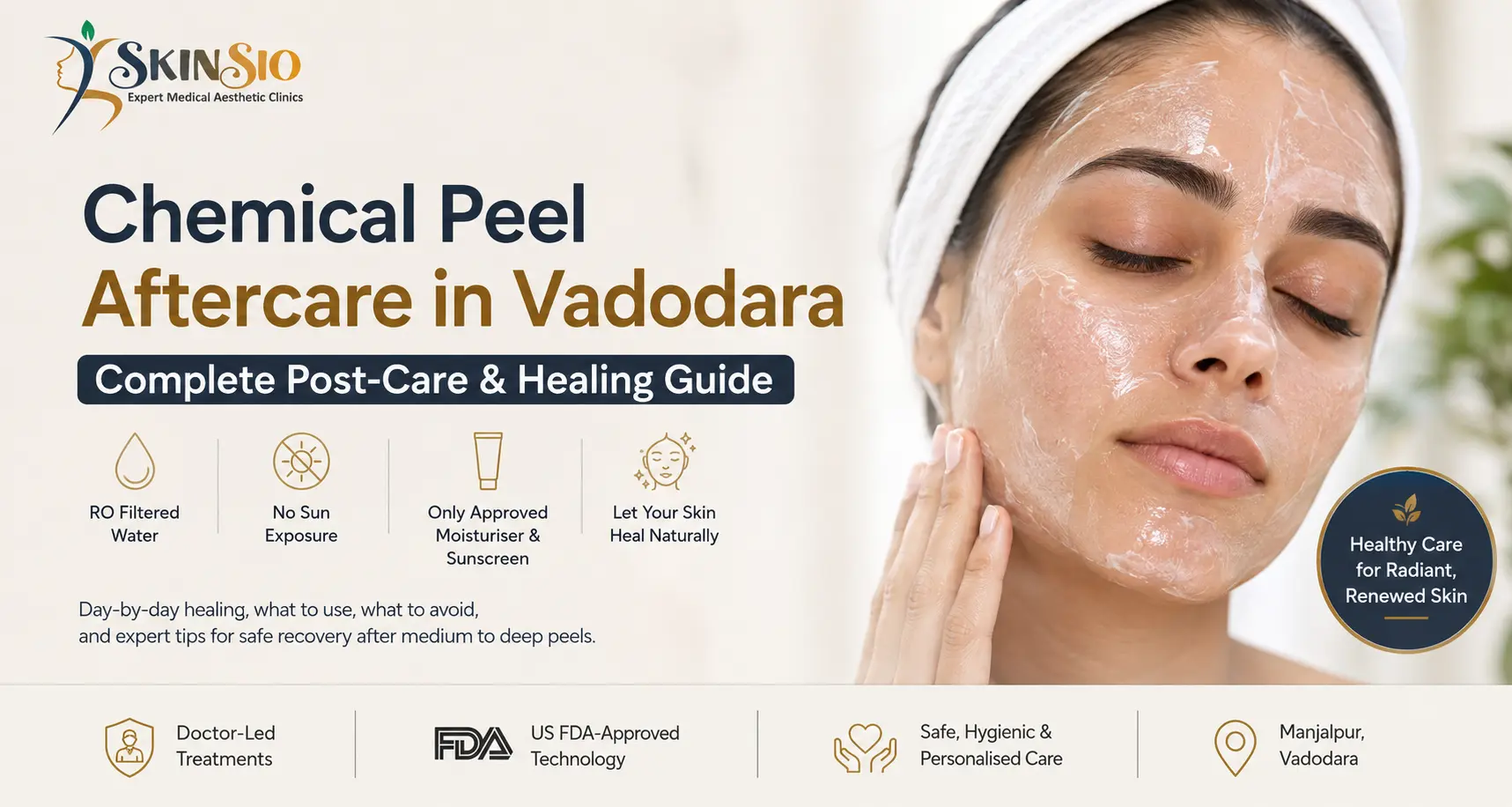
Medical review: SkinSio Clinics Medical Team | Location: Manjalpur, Vadodara, Gujarat | Last updated: August 2026
A chemical peel can make the skin look dramatically different over the following days — red, tight, dry, darker, flaky and eventually smoother and more even. For patients undergoing a medium-depth or deeper chemical peel, knowing what is normal and what is not can make the recovery much less stressful.
This complete chemical peel aftercare guide explains what happens to your skin after a peel, when peeling usually starts, why the skin may become dark brown before shedding, what to apply, what to avoid, how long healing takes, and when you should contact your dermatologist.
If you have recently undergone a chemical peel in Vadodara, follow this guide together with the specific instructions given by your treating doctor. Your doctor's instructions always take priority because peel depth, chemical used, concentration, skin type and individual healing can significantly change the recovery process.
Quick Answer: What Should You Do After a Medium or Deep Chemical Peel?
After a stronger chemical peel, your skin needs protection rather than more treatment. The most important rules are:
- Strictly avoid direct sun exposure
- Do not pick, pull, rub or manually remove peeling skin
- Do not use scrubs, exfoliating acids or retinoids unless your doctor tells you to restart them
- Avoid makeup until your provider confirms the skin barrier has adequately healed
- Avoid unnecessary sweating, strenuous exercise and activities that generate excessive heat during early healing
- Avoid facials, lasers, waxing, threading and other cosmetic procedures until your provider clears them
- Keep yourself well hydrated
- Follow your clinic's wound-care instructions exactly
- For SkinSio patients undergoing a deeper peel, use only RO-filtered water for facial cleansing for the first 7 days when specifically instructed by your provider
- Do not introduce new skincare products during recovery
- Use moisturiser or a prescribed healing product only as advised by your provider, particularly after a deeper peel
- Use sunscreen only once your provider says the skin has healed sufficiently to tolerate it
The most important principle is simple: do not try to speed up the peeling process. Let the skin heal at its own pace.
What Is a Chemical Peel?
A chemical peel is a controlled dermatological procedure in which a chemical solution is applied to the skin to produce a predictable degree of exfoliation and injury. The controlled injury stimulates the skin's natural healing process and allows damaged superficial layers to shed while newer skin develops underneath.
Depending on the chemical used, concentration, number of coats, application technique and intended depth, a peel can be classified broadly as superficial, medium-depth or deep. Chemical peels may be used for concerns such as acne, post-acne pigmentation, uneven skin tone, certain forms of melasma, sun damage, fine lines, rough texture, photodamage, selected superficial acne scars, and certain pigmentation disorders.
However, not every peel is suitable for every skin concern. This is especially important for Indian skin, where post-inflammatory hyperpigmentation (PIH) can occur after skin injury. Medium and deep peels therefore require careful patient selection, appropriate preparation and strict photoprotection.
Superficial, Medium and Deep Chemical Peels: Not the Same Procedure
The term "chemical peel" describes a broad family of procedures. A mild peel and a deep peel should not be thought of as the same treatment at different strengths.
Superficial peels — glycolic, salicylic, mandelic, lactic acid, or Jessner-type formulations — primarily affect the outermost layers of the epidermis and are commonly used for acne, oiliness, dullness and superficial pigmentation, with generally limited downtime.
Medium-depth peels — TCA (trichloroacetic acid) is the best-known agent, though actual depth depends on concentration, number of coats and technique — penetrate further and produce a more significant controlled injury. These may be considered for photodamage, fine lines, uneven pigmentation, selected superficial scars, and textural concerns, generally producing more visible redness, tightness and peeling than superficial peels.
Deep chemical peels — historically phenol-based, though TCA can also be used at deeper depths — produce a substantially deeper injury and a much more intensive healing process. Deep peeling is not simply "a stronger facial peel"; it is a medical procedure with potentially significant complications, including infection, scarring, persistent redness, pigmentary changes, and delayed healing. It should never be performed casually or as a salon procedure. For Indian and other skin-of-colour patients, deep peels are approached much more cautiously because of the risk of prolonged pigmentary complications.
What Does a Medium-to-Deep Peel Actually Do?
Think of a peel as a controlled reset followed by a healing and regeneration phase. The chemical solution causes controlled disruption of skin cells and, depending on depth, protein coagulation and injury within the targeted layers. The body then begins a repair process: the treated skin becomes inflamed, the skin barrier is temporarily compromised, the skin becomes tight and dry, damaged tissue begins to separate and shed, new epidermal tissue develops, redness gradually settles, and pigment and texture continue to stabilise over subsequent weeks. This is why the first few days after a peel can sometimes look worse before they look better.
Who Should NOT Get a Medium or Deep Peel Without Medical Assessment
A dermatologist should evaluate your medical history and skin before proceeding. Potential contraindications or important precautions include active skin infection, open wounds or broken skin, active herpes infection, significant active inflammation, recent significant sunburn, poor wound healing, certain autoimmune or connective-tissue conditions, uncontrolled diabetes, immunosuppression, pregnancy or breastfeeding depending on the peel, recent isotretinoin exposure, a history of abnormal scarring or keloids, significant photosensitivity, certain medications, and recent prior medium/deep peeling procedures. The exact contraindications depend on the agent and depth being considered — a medical consultation is not simply a formality before a deeper peel.
Chemical Peel Healing Process: What Happens Day by Day
One of the most common questions patients ask after a peel is "is this normal?" — and usually, the answer depends on the depth of the peel. There is no universal day-by-day schedule, since different chemicals and skin types heal differently, but the following is a useful general framework.
Day 0–1: Immediately After the Peel
Your skin may feel warm, tight, sensitive, mildly burning or stinging, red, and swollen in some areas. A medium-depth peel may produce more obvious redness and discomfort, while a deep peel can involve much more significant wound care and may require dressings or specific medical products — the American Academy of Dermatology notes that deep chemical peels can create a wound requiring surgical dressing, with recovery taking several weeks. Do not add your own face wash, serum, vitamin C, retinol, exfoliant, scrub, facial oil, or home remedy unless specifically instructed.
Day 2–3: Tightness and Dryness
The skin can start feeling extremely dry and tight — many patients describe it as "my face feels stretched." This is often part of the healing process. You may notice increased tightness, dryness, darkening, mild swelling, more visible texture and early flaking. Do not panic if your face does not immediately look brighter; the skin is still healing.
Day 3–4: The Peeling Phase May Begin
For many patients, visible peeling becomes more obvious around the third or fourth day, though this timing is not universal — some start earlier, others take longer. The skin can become very dry, tight, brownish, dark brown, flaky, patchy and uneven in colour. This stage often causes unnecessary anxiety.
Why does the skin sometimes become dark brown? As the treated tissue dries and undergoes controlled shedding, the surface can temporarily look darker or brown. This does not automatically mean the peel has failed or that permanent pigmentation has developed. However, unusually severe darkening, blistering, increasing pain or other concerning symptoms should be assessed by your treating provider.
Days 4–7: Peeling and Shedding
This is when many patients notice the most visible peeling — in small flakes, larger sheets, patches, or thin brown superficial layers. The most important rule during this phase: do not peel the peel. Do not pull loose skin, scratch, pick flakes, use a scrub, rub with a towel, use a facial cleansing brush, or try to "help" the skin come off. Let it detach naturally. Pulling prematurely can cause unnecessary trauma and increase the risk of pigmentation, infection or scarring — the AAD specifically advises against rubbing or scratching healing skin for exactly this reason.
Days 7–14: New Skin Becomes More Visible
As shedding reduces, newer skin begins to appear — smoother texture, reduced dullness, more even-looking skin, pink or reddish tone, temporary sensitivity, and residual dryness. Do not assume the final result is visible yet; the skin may continue changing for weeks.
Weeks 2–6: Remodelling and Stabilisation
The visible peeling may have finished, but healing is not necessarily complete. The skin barrier continues recovering, redness and sensitivity gradually decrease, and pigmentation and texture continue to settle. This is also why aggressively adding multiple skincare products immediately after peeling is usually a mistake — new skin does not mean "ready for everything." Your provider should decide when you can gradually restart active skincare.
Complete Chemical Peel Aftercare Routine
1. Follow Your Provider's Instructions First
There is no single universal aftercare routine for every chemical peel. A superficial glycolic peel, a medium-depth TCA peel and a deep phenol peel do not have identical wound-care requirements. Your treating doctor knows which chemical was used, the concentration, number of coats, intended depth, your skin type, medical history and expected healing pattern — follow that specific protocol.
2. Cleansing: Use Only What Your Provider Allows
For patients following the SkinSio deeper-peel protocol, your provider may instruct you to clean the face with only RO-filtered water for the first 7 days, or for another duration depending on the treatment. This is deliberately different from your normal daily skincare routine. During this period, do not independently introduce face wash, cleansing foam, scrub, micellar water, cleansing balm, toner, or exfoliating cleanser unless your provider specifically tells you otherwise. If your dermatologist has prescribed a wound cleanser, dressing, or ointment, follow that medical protocol instead.
3. Strictly Avoid Sun Exposure
This is one of the most important parts of chemical peel aftercare. UV exposure during healing can increase inflammation and may worsen pigmentation. For Indian skin, photoprotection is particularly important because post-inflammatory hyperpigmentation is a significant concern after procedures that injure the skin. Avoid direct sunlight, outdoor activities, sunbathing, terrace exposure, long car rides with direct sun, and outdoor sports. Use physical protection — umbrella, hat/cap, protective clothing, shade — whenever you need to travel. Your provider will advise when sunscreen can safely be introduced.
4. Sunscreen — But at the Right Stage
Sunscreen is an important part of post-peel pigmentation prevention. However, a deeper peel can leave the skin temporarily wounded, and sunscreen should not simply be applied over an open or actively healing wound unless your provider has instructed you to do so. Once your provider confirms the skin barrier has healed sufficiently, use the recommended broad-spectrum sunscreen consistently, reapply as directed, and continue strict photoprotection even after peeling has stopped.
5. Moisturiser: Only If Your Provider Advises It
For many superficial or medium-depth peels, moisturisation is an important part of maintaining the healing skin barrier, but the appropriate product and timing after a deeper peel can differ. Do not choose a random moisturiser simply because your face feels dry — if your SkinSio provider has prescribed or approved a moisturiser/emollient, use it exactly as instructed. The goal is to keep healing skin protected, not to overload it with skincare.
6. No Face Wash Unless Cleared
This deserves its own rule because it is one of the most common mistakes patients make. Your normal cleanser may contain surfactants, fragrance, acids, exfoliating ingredients, or active acne ingredients — inappropriate during the early healing phase after a stronger peel. Do not restart your normal skincare routine simply because the face feels dirty.
7. No Scrubs or Exfoliation
Absolutely avoid physical scrubs, face brushes, exfoliating gloves, AHA, BHA, PHA, retinol, retinal, tretinoin, strong vitamin C formulations, and peeling masks until your provider says they can be restarted. Your skin is already undergoing controlled exfoliation — it does not need additional exfoliation.
8. No Makeup During Active Healing
Avoid foundation, concealer, compact powder and other makeup products while the skin is actively peeling or wounded, unless your treating provider specifically permits them. Makeup application also involves touching, rubbing, brushes, sponges and later cleansing — all of which can unnecessarily disturb fragile skin. For a deeper peel, your provider should determine when makeup can safely resume.
9. No Facial Treatments
Do not schedule another cosmetic treatment simply because the skin appears uneven. Avoid HydraFacial, facials, carbon laser, laser treatments, MNRF, microneedling, waxing, threading, bleaching, cleanup, dermaplaning, microdermabrasion, or other chemical peels unless specifically cleared. Your skin needs time to recover before another procedure is considered.
10. Avoid Exercise and Excessive Sweating
During early recovery, avoid activities that produce significant sweating, heat, facial flushing or friction — gym workouts, running, cycling, heavy weight training, intense yoga, and outdoor sports. Your provider may give a specific restriction period based on peel depth; for deeper peels, follow the stricter timeline given by your medical team.
11. Avoid Steam, Sauna and Excessive Heat
Avoid steam rooms, saunas, very hot showers, facial steaming and heat-based treatments. The goal during early recovery is to keep the healing environment calm and protected.
12. Stay Away From Dust and Pollution
This is particularly relevant in an urban environment like Vadodara. During active peeling, minimise unnecessary exposure to road dust, construction dust, traffic pollution, industrial environments and dirty outdoor surfaces. If you need to travel, follow your provider's instructions for protecting the treated skin.
13. Stay Well Hydrated
Hydration does not magically "heal" a chemical peel overnight, but maintaining adequate fluid intake supports normal physiological function during recovery. Drink adequate water throughout the day, prioritise balanced meals, adequate protein, fruits and vegetables, normal sleep, and avoid excessive alcohol. Do not rely on supplements or "skin detox" drinks as a substitute for proper medical aftercare.
The Biggest Mistake: Picking the Peeling Skin
This deserves emphasis. When a piece of skin is hanging from the face, it can be extremely tempting to remove it. Don't. The skin underneath may still be immature and vulnerable. Pulling can cause raw areas, bleeding, increased inflammation, infection, pigmentary changes, delayed healing and scarring. Let the skin detach naturally.
What Should You NOT Put on Your Face After a Chemical Peel?
Unless specifically prescribed or approved by your provider, avoid experimenting with DIY remedies — lemon, baking soda, turmeric mixtures, honey masks, besan, toothpaste, unverified aloe vera products, or essential oils. Also avoid active skincare — retinol, retinal, tretinoin, glycolic acid, salicylic acid, lactic acid, strong vitamin C, benzoyl peroxide, or exfoliating toners — and cosmetic products such as scrubs, face packs, bleach, makeup, perfumed creams, or new skincare products. The post-peel period is not the time to experiment.
Is Dark Brown Skin After a Chemical Peel Normal?
Sometimes. During the healing process, treated skin can become darker, dry and brown before it sheds. However, darkening should never automatically be dismissed as "normal peeling." There is an important difference between expected post-treatment colour change and complications such as significant post-inflammatory hyperpigmentation, excessive inflammation, infection or other injury. This is particularly important for Fitzpatrick III–VI skin, where pigmentary complications deserve special attention. If you are worried about the colour change, send a photograph to your treating provider or attend a review rather than attempting to treat it yourself.
When Should You Contact Your Dermatologist?
Contact your treating clinic if you develop increasing rather than improving pain, significant swelling, blistering, pus or discharge, foul odour, fever, spreading redness, severe burning, unexpected bleeding, new severe pigmentation, areas that appear unusually pale or white, signs of infection, delayed healing, or any symptom that feels significantly different from what your doctor explained. Do not wait several days hoping a concerning symptom will disappear.
Chemical Peel Aftercare for Indian Skin: Why Extra Care Matters
One of the most important differences between chemical peeling in lighter and darker skin is the risk of post-inflammatory hyperpigmentation and dyschromia. Indian skin commonly falls within Fitzpatrick III–V, although individual skin tones vary considerably. Skin-of-colour patients can develop more noticeable pigmentation following inflammation or injury — which is why the concentration, depth, preparation and aftercare of a chemical peel should be customised rather than selected from a generic online protocol.
A deeper peel is therefore not automatically a better peel. The correct peel provides an appropriate balance between expected benefit, controlled depth, skin type, indication, acceptable downtime, and safety.
Medium vs Deep Chemical Peel: Recovery at a Glance
| Feature | Superficial | Medium-depth | Deep |
|---|---|---|---|
| Depth | Epidermal | Deeper epidermis / upper dermis | Deep dermal injury |
| Peeling | Usually mild | More visible | Significant |
| Downtime | Short | Several days to ~1–2 weeks | Often several weeks |
| Medical supervision | Important | Essential | Essential |
| Pigment risk | Lower but possible | Higher | Significant |
| Scarring risk | Low | Higher | Higher |
| Suitability for Indian skin | Depends on peel | Requires careful selection | Requires exceptional caution |
Recovery varies considerably between individuals and peel types. The AAD notes that deep chemical peels can require approximately 2–3 weeks of recuperation, while medium-depth peels have shorter but still meaningful downtime.
Chemical Peel Aftercare: The Simple 7-Day Rule
If your provider has given you a 7-day strict aftercare protocol, think of the first week as a protection phase. For the first 7 days, unless your doctor has given different instructions:
- Use only the permitted cleansing method — for the SkinSio deeper-peel protocol, this may mean RO-filtered water only
- Do not pick or pull peeling skin
- Avoid direct sunlight completely, and unnecessary outdoor exposure
- Do not use face wash, scrub, acids, retinoids or makeup unless cleared
- Do not perform facials, laser or other cosmetic procedures
- Avoid heavy exercise, excessive sweating, steam and sauna
- Avoid dust and pollution as much as practical
- Stay adequately hydrated; use moisturiser only if advised
- Introduce sunscreen only once your provider confirms your skin is ready
What Happens If You Don't Follow Chemical Peel Aftercare?
Poor aftercare can interfere with healing and increase the risk of complications, including prolonged redness, irritation, excessive dryness, infection, post-inflammatory hyperpigmentation, hypopigmentation, delayed healing and scarring. This does not mean complications are inevitable after a peel — proper patient selection, appropriate peel depth, medical technique and aftercare substantially influence the safety of the procedure.
Can You Speed Up Chemical Peel Recovery?
Not safely. There is no product that should be used to force the skin to peel faster. Trying to accelerate the process with scrubbing, picking, acid products, retinol, strong exfoliants or home remedies can create more inflammation and potentially worsen pigmentation. The goal isn't to peel faster — the goal is to heal correctly.
When Can You Restart Your Normal Skincare?
There is no universal "Day 7 = everything is safe" rule. Your provider should assess whether peeling has finished, whether the skin barrier has recovered, whether redness or tenderness remains, whether the skin is still unusually sensitive, and whether any areas remain raw. Only then should active products be gradually reintroduced — this is particularly important after medium-depth and deep peels.
The Bottom Line: Treat the Healing Phase as Part of the Procedure
A chemical peel does not end when the chemical solution is removed — the recovery period is part of the treatment. The best results come from respecting the healing process: protect, hydrate appropriately, don't pick, avoid sun, avoid unnecessary products, follow medical instructions, and allow the skin to heal. If your skin looks dry, tight, brown or flaky during the first several days, don't panic and don't start experimenting with skincare. And if something looks or feels significantly different from what your provider told you to expect, contact your clinic.
Chemical Peel Treatment in Vadodara: Why Medical Supervision Matters
If you are considering a medium-depth or deeper chemical peel in Vadodara, don't choose a peel simply by its advertised concentration or price. Ask who is assessing your skin, what exact peel is being recommended and why, what your risk of post-inflammatory hyperpigmentation is, what preparation is required, what to expect during the first week, what happens if you develop excessive irritation, who will review you during recovery, and exactly what to apply — and avoid.
At SkinSio Clinics, Manjalpur, Vadodara, chemical-peel treatment is planned according to the patient's skin concern, skin type, treatment goals and expected downtime rather than using one standard peel for everyone. Our broader treatment approach is doctor-led and already covers acne, pigmentation, acne scars and other skin concerns where chemical peels may form part of a personalised treatment plan. If melasma is part of your picture, our dedicated melasma treatment guide explains why aggressive peeling is approached cautiously for that condition specifically.
Book a Chemical Peel Consultation in Vadodara
If you're considering a chemical peel for pigmentation, acne, acne marks, uneven skin tone, sun damage or skin texture, a proper skin assessment should come before choosing the peel.
SkinSio Clinics
2nd Floor, The Atlantic, A/203, Makarpura Road, beside Indian Oil Petrol Pump, Near D-Mart, Manjalpur, Vadodara, Gujarat 390010
Phone / WhatsApp: +91 93220 22392
Clinic hours: Monday–Saturday 10:30 AM–7:00 PM; Sunday 10:30 AM–3:00 PM by appointment.
Medical Disclaimer
This article is intended for educational purposes and does not replace an examination or personalised advice from a qualified dermatologist or medical professional. Chemical peel recovery varies according to the chemical agent, concentration, application technique, treatment depth, skin type, medical history and individual healing response. If you have already undergone a medium-depth or deep chemical peel, follow the specific aftercare instructions provided by your treating doctor. If those instructions differ from this general guide, your treating doctor's instructions should take priority.
Frequently Asked Questions
When does skin start peeling after a chemical peel?
Visible peeling commonly becomes noticeable around days 2–4 for some medium-depth treatments, but the timing varies according to the chemical used, depth, concentration and individual healing response.
Why is my skin dark brown after a chemical peel?
Treated skin can temporarily become darker, dry and brown during the shedding phase. However, significant or worsening pigmentation should be reviewed by your treating dermatologist because post-inflammatory hyperpigmentation is a recognised complication, particularly in darker skin types.
Can I wash my face after a chemical peel?
Only according to your provider's instructions. Some superficial peels allow gentle cleansing relatively quickly, whereas deeper peels may require a more specific wound-care protocol. At SkinSio, certain deeper-peel protocols may involve using only RO-filtered water for the first seven days.
Can I use sunscreen after a chemical peel?
Sunscreen is an important part of photoprotection after chemical peeling, but after a deeper peel the skin may initially require medical wound care. Use sunscreen when your provider confirms that your skin is ready to tolerate it, and continue strict sun protection thereafter.
Can I exercise after a chemical peel?
Avoid strenuous exercise and excessive sweating during the early recovery period. Your exact restriction depends on the depth of the peel and your provider's instructions.
Can I remove peeling skin myself?
No. Do not pull, scratch or manually remove peeling skin. Pulling prematurely can cause raw areas, bleeding, infection, pigmentary changes and scarring. Let it detach naturally.
Is a deep chemical peel safe for Indian skin?
Deep chemical peels require particular caution in Indian and other darker skin types because of the risk of pigmentation changes and scarring. The decision should be based on the indication, skin type, medical history and risk-benefit assessment — not simply the desired strength of the peel.
Is more peeling equal to better results?
No. More visible peeling does not automatically mean a better outcome. The objective is controlled treatment at the appropriate depth, not maximum peeling.