
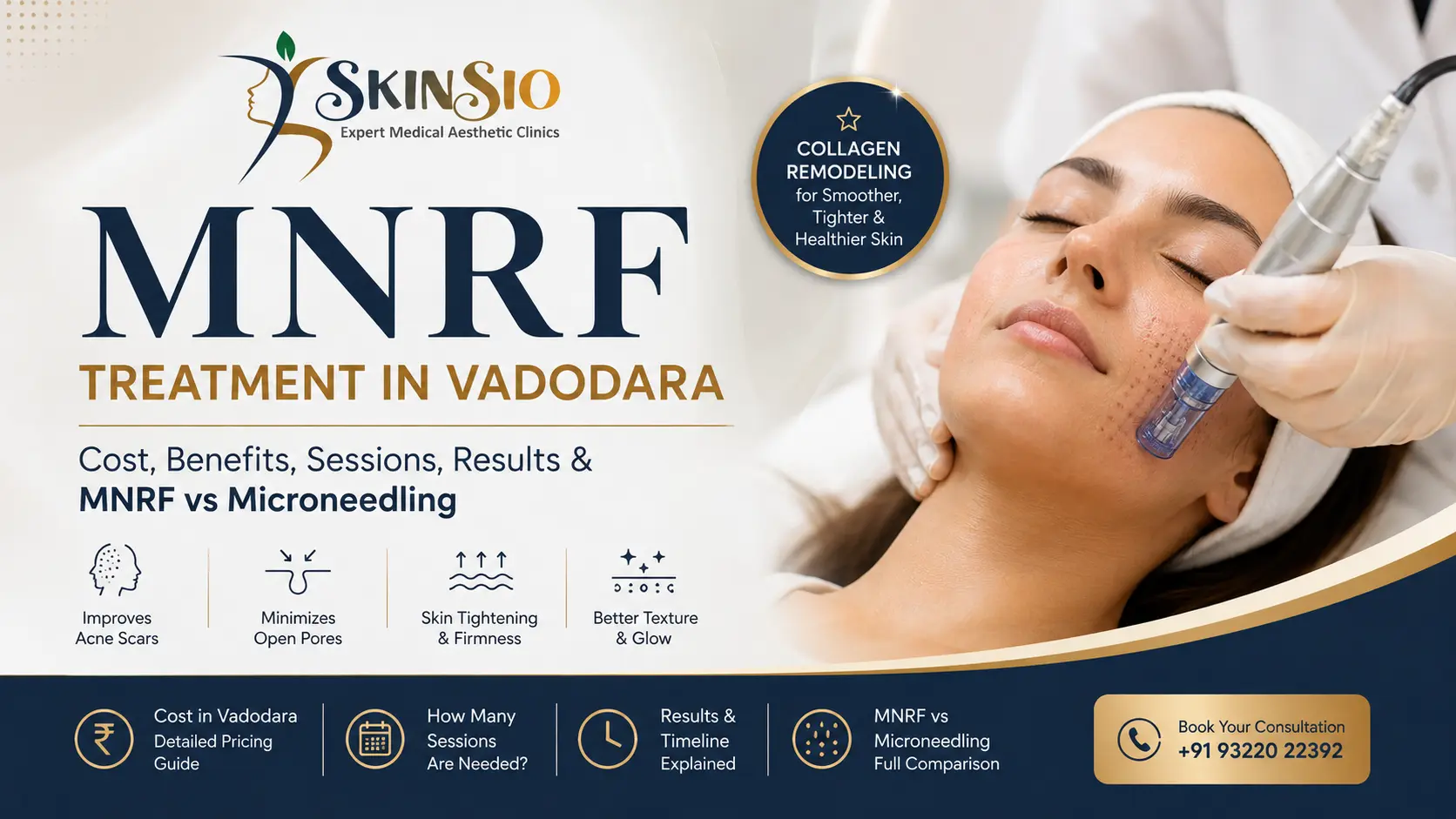
MNRF Treatment in Vadodara: More Than "Microneedling with a Machine"
MNRF (Microneedling Radiofrequency) is increasingly used at SkinSio Clinics, Vadodara for acne scars, enlarged pores, uneven skin texture, fine lines, and mild-to-moderate skin laxity. It is often described as "microneedling with a machine," but that undersells what's actually happening — MNRF combines controlled microneedling with radiofrequency (RF) energy to stimulate collagen deeper within the skin than mechanical needling alone can reach.
This guide explains how MNRF actually works, which concerns it genuinely helps with, how it compares to regular microneedling and fractional laser, realistic session counts and timelines, safety considerations for Indian skin, and transparent pricing at SkinSio Clinics.
What Is MNRF, and How Does It Work?
MNRF combines two mechanisms in a single device: fine needles create controlled microscopic channels in the skin, and radiofrequency energy delivers controlled heat into the deeper dermal layers through those same needles. This dual action stimulates the skin's natural wound-healing response and collagen remodelling more deeply than mechanical microneedling alone.
Because RF energy is delivered at a controlled depth through the needles rather than relying purely on surface-level mechanical injury, MNRF can target deeper dermal tissue while limiting unnecessary damage to the skin surface — which is also part of why it tends to suit darker, pigmentation-prone skin reasonably well. The visible improvement doesn't happen entirely on the day of treatment: your skin continues its collagen-remodelling process for weeks to months afterward, which is why MNRF results generally develop progressively rather than immediately.
What Can MNRF Actually Treat?
MNRF is useful for several distinct concerns, though treatment settings and expected outcomes differ by condition — which is exactly why a proper assessment comes before treatment at SkinSio Clinics rather than a fixed, one-protocol-fits-all approach.
Acne Scars
MNRF can be particularly useful for selected atrophic acne scars, including rolling and some boxcar scars. Not every acne scar should automatically go to MNRF, though — deep ice-pick scars, tethered rolling scars, and certain mixed patterns often need a combination approach such as TCA CROSS, subcision, or fractional laser, which our detailed acne scar treatment guide covers by scar type.
Enlarged Open Pores
MNRF can improve the appearance of enlarged pores by strengthening collagen support and improving overall skin texture, though results are gradual and depend on the underlying cause of pore enlargement.
Skin Laxity
MNRF can provide a degree of tightening and firmness by stimulating dermal collagen. It's most appropriate for mild-to-moderate laxity rather than severe sagging that would require surgical correction.
Fine Lines and Early Skin Ageing
By stimulating collagen remodelling, MNRF can improve certain fine lines and overall skin quality — though it's better suited to improving texture than to replacing lost facial volume (a role for fillers) or relaxing dynamic wrinkles (a role for Botox).
Stretch Marks
MNRF may be incorporated into treatment plans for selected stretch marks, particularly when texture and dermal collagen changes are the main concern. Response varies with the age, colour, depth, and location of the marks — our scar and stretch mark treatment guide covers how MNRF compares to other stretch mark options in more depth.
MNRF vs Microneedling: What's the Real Difference?
| Feature | Regular Microneedling | MNRF / RF Microneedling |
|---|---|---|
| Mechanical microneedling | Yes | Yes |
| Radiofrequency energy | No | Yes |
| Main mechanism | Controlled micro-injury | Micro-injury + RF thermal stimulation |
| Skin tightening | Limited | More targeted |
| Downtime | Usually low | Usually low to moderate |
| Cost | Generally lower | Generally higher |
| Best suited for | Texture, mild scars, general rejuvenation | Scars, pores, texture and selected laxity |
Neither treatment is universally "better." The right choice depends on your skin type, scar type and depth, degree of laxity, treatment area, previous treatments, downtime tolerance, and overall goal. For some patients, conventional microneedling is genuinely sufficient; for others, MNRF's added RF component makes more sense. This should be decided after examining the skin — not by default, simply because MNRF is the newer machine.
MNRF vs Fractional Laser for Acne Scars
Both MNRF and fractional lasers are used for acne scar improvement, but they work differently. Fractional laser creates controlled columns of thermal injury in the skin, while MNRF delivers RF energy through microneedles at controlled depths. For Indian skin tones specifically, MNRF can be an attractive option because it delivers dermal treatment with relatively limited disruption to the epidermal surface — reducing the post-inflammatory hyperpigmentation risk that comes with more aggressive ablative lasers, a topic we cover in more depth in our laser skin treatment guide.
That said, fractional laser isn't automatically inferior. Some scar types genuinely respond better to laser resurfacing, while others do better with MNRF or a combination of treatments. For complex acne scarring, the best plan often involves multiple modalities rather than repeating a single procedure.
How Many MNRF Sessions Are Needed?
There's no universal number. For many patients, a treatment course involves approximately 3–5 sessions, commonly spaced 4–6 weeks apart. The exact number depends on severity, acne-scar type, skin quality, treatment area, needle depth and RF settings, previous treatments, and individual healing response. Importantly, more sessions do not automatically mean better results — treatment should be adjusted according to how your skin actually responds, not a fixed package.
When Will You See MNRF Results?
MNRF is not an instant-result procedure. You may notice early textural improvement as initial healing settles, but meaningful collagen remodelling takes time:
- First few days: temporary redness, mild swelling, and pinpoint marks may occur
- First few weeks: skin gradually settles and early textural improvement may become noticeable
- 1–3 months: collagen remodelling continues and improvement becomes more apparent
- 3–6 months: the fuller effect of collagen remodelling may continue to develop, depending on the individual and the indication
For acne scars specifically, the objective is progressive improvement rather than complete removal. Deep scars may become shallower and less noticeable, but no responsible clinic should promise every acne scar will disappear entirely.
Is MNRF Safe for Indian Skin?
MNRF can be a genuinely useful option for Indian skin when appropriate settings, treatment depths, and aftercare are followed. One reason it's often considered suitable is that RF energy is delivered through the treatment needles into the dermis, rather than relying entirely on aggressive surface-level thermal injury — a distinction that matters for pigmentation-prone Fitzpatrick III–V skin.
That said, no energy-based procedure is completely risk-free. Possible temporary effects include redness, mild swelling, warmth or tenderness, pinpoint marks, temporary dryness or flaking, and temporary pigmentation changes in susceptible individuals. Rare complications can occur, particularly with inappropriate settings or technique — which is why the expertise of the treating clinician and correct device settings matter as much as the technology itself.
Is MNRF Painful, and What's the Downtime?
Most patients tolerate MNRF well when appropriate topical anaesthesia is used — a numbing cream is generally applied before treatment. During the procedure, patients may experience pressure, pinching, warmth, pricking, or brief vibrating heat sensations, with discomfort varying by treatment depth, area, and individual sensitivity.
MNRF generally has less downtime than aggressive ablative resurfacing, though it varies with treatment intensity. Expect possible redness, mild swelling, pinpoint marks, mild sensitivity, or dryness and flaking. Many patients resume normal activities within a few days, though the skin should be treated gently during recovery — your clinician will provide aftercare instructions specific to your settings and skin.
MNRF Aftercare
- Protect your skin from the sun — avoid unnecessary direct sun exposure during early healing and use broad-spectrum sunscreen as advised
- Keep skincare simple — use the gentle cleanser, moisturiser, and healing products recommended by your clinician
- Avoid strong actives temporarily — retinoids, exfoliating acids, and other potentially irritating products may need to pause for a period after treatment
- Avoid unnecessary touching — let the skin heal without excessive rubbing, picking, or scratching
- Follow makeup guidance — depending on treatment intensity, you may need to avoid makeup for a short period
Your exact aftercare should always take priority over generic internet advice, since it accounts for your specific settings and skin response.
Can MNRF Be Combined With Other Treatments?
Yes — in appropriately selected patients, MNRF is often incorporated into a combination treatment plan rather than used alone. For acne scars specifically, a dermatologist may consider combinations involving MNRF, subcision, TCA CROSS, fractional laser, standard microneedling, PRP, or chemical peels. The important principle is that combination treatment should be based on scar morphology, not the assumption that "more treatments are automatically better." Different scar types genuinely need different approaches — our PRP therapy guide covers how PRP is frequently layered with MNRF to accelerate collagen quality between sessions.
Why Diagnosis Matters More Than the Machine
Acne scars are not one single condition. A patient may have rolling scars (broad depressions with tethering underneath), boxcar scars (more sharply defined depressions with distinct edges), ice-pick scars (narrow, deeper scars extending into the skin), or a mixed pattern combining several types. A patient with predominantly rolling scars may benefit from a different strategy than someone with deep ice-pick scars — which is why "Should I get MNRF for my acne scars?" is the wrong first question. The better question is which combination of treatments is appropriate for your particular scar pattern, and that answer comes from an assessment, not a marketing page.
What MNRF Cannot Do
MNRF is a genuinely useful tool, but it isn't a replacement for every aesthetic treatment. It does not permanently erase every acne scar, replace Botox for dynamic wrinkles, replace fillers for significant volume loss, replace surgery for severe skin sagging, produce identical results in every patient, or guarantee a specific percentage of improvement. Good aesthetic treatment is about realistic improvement, not unrealistic promises — a principle we apply consistently across every treatment guide on this site.
MNRF Treatment Cost in Vadodara
The cost of MNRF treatment in Vadodara varies considerably because treatment plans differ between patients. Factors that influence price include the area being treated (face vs neck vs body), number of sessions, severity of the condition, the specific MNRF technology used, and whether combination treatments or PRP are recommended alongside it.
As a broad Vadodara market reference, RF microneedling is commonly priced in the approximate range of ₹6,500–₹15,000 per session, depending on the clinic, treatment area, technology and treatment plan. Published local pricing varies, so patients shouldn't select a clinic purely on the basis of the lowest quoted price. At SkinSio Clinics, the appropriate treatment plan and current pricing are determined after assessing the skin and treatment area — a consultation is particularly important for acne scars, since the number of sessions and any combination procedures can vary significantly from person to person.
Call or WhatsApp +91 93220 22392 for current rates.
How to Choose an MNRF Clinic in Vadodara
When comparing clinics, don't compare only the price per session. Ask who will assess and perform the treatment — ideally a qualified medical professional familiar with skin conditions and aesthetic procedures. Ask which MNRF device is being used and whether the clinic can explain why it's appropriate for your specific concern. For acne scars, confirm the doctor has identified your scar type before recommending MNRF, and be cautious of guarantees on session count. Finally, ask what the total treatment plan looks like — a low per-session price isn't the lowest total cost if the treatment is poorly matched to the problem — and what happens if MNRF alone isn't enough.
Why Choose SkinSio Clinics for MNRF in Vadodara
At SkinSio Clinics, Manjalpur, Vadodara, MNRF is positioned as part of a doctor-led approach to medical aesthetics rather than a one-size-fits-all procedure. Treatment parameters are selected according to your specific concern, skin characteristics, and treatment goals — with access to other procedures when MNRF alone isn't the best approach, including acne scar treatments, PRP, and lasers. The goal is never to sell a particular machine or package — it's to select the treatment that makes medical and aesthetic sense for your skin.
Conclusion
MNRF treatment in Vadodara can be a genuinely effective option for selected acne scars, enlarged pores, uneven texture, and mild skin laxity. Its major advantage over conventional microneedling is the addition of controlled radiofrequency energy, providing another mechanism for stimulating dermal collagen remodelling. But MNRF is not a magic treatment — the best results come from matching the procedure to the problem. For acne scars especially, the type and depth of the scar should determine the treatment strategy, rather than simply choosing MNRF because it's the newer, more popular option. If you're considering MNRF, a proper skin assessment at SkinSio Clinics can help determine whether you're better suited to MNRF, microneedling, fractional laser, subcision, TCA CROSS, PRP, or a combination approach.
Frequently Asked Questions
What is MNRF treatment?
MNRF stands for Microneedling Radiofrequency. It combines controlled microneedling with radiofrequency energy delivered through the needles into the dermis, triggering collagen remodelling at a controlled depth. Unlike regular microneedling, which relies purely on mechanical micro-injury, MNRF adds thermal RF stimulation for deeper, more targeted collagen rebuilding.
Is MNRF better than regular microneedling?
Not universally — it depends on your specific concern. MNRF's added radiofrequency component gives it an edge for deeper acne scars, enlarged pores, and skin laxity, while conventional microneedling may be sufficient for milder texture concerns. A proper assessment of your scar type and skin condition determines which is the better fit.
How many MNRF sessions are needed?
Most treatment courses involve approximately 3–5 sessions spaced 4–6 weeks apart, though this varies based on severity, scar type, skin quality, and individual healing response. More sessions don't automatically mean better results — treatment is adjusted according to how your skin responds.
When will I see MNRF results?
MNRF is not an instant-result procedure. Early textural improvement may appear within the first few weeks as initial healing settles, with collagen remodelling continuing to develop over 1–3 months and the fuller effect visible at 3–6 months, depending on the individual and the concern being treated.
What does MNRF treatment cost in Vadodara?
As a broad Vadodara market reference, RF microneedling is commonly priced in the range of ₹6,500–₹15,000 per session, depending on the clinic, treatment area, technology and treatment plan. At SkinSio Clinics, the appropriate plan and current pricing are confirmed after assessing your skin and treatment area. Call +91 93220 22392 for current rates.
Is MNRF safe for Indian skin?
Yes. Because RF energy is delivered through the needles into the dermis rather than relying on aggressive surface-level heating, MNRF is generally well suited to Indian (Fitzpatrick III–V) skin. As with any energy-based procedure, correct settings and an experienced clinician matter as much as the technology itself.
Does MNRF hurt, and is there downtime?
A numbing cream is applied before treatment, and most patients tolerate the procedure well, describing sensations of pressure, warmth, or mild pricking. Downtime is generally low — redness, mild swelling, and pinpoint marks may occur, with many patients resuming normal activities within a few days.
Can MNRF treat acne scars completely?
No responsible clinic should promise complete removal of every acne scar. For atrophic acne scars specifically, MNRF's goal is progressive improvement — scars typically become shallower and less noticeable rather than disappearing entirely. Deep ice-pick or tethered rolling scars often need a combination approach with subcision, TCA CROSS, or fractional laser.