
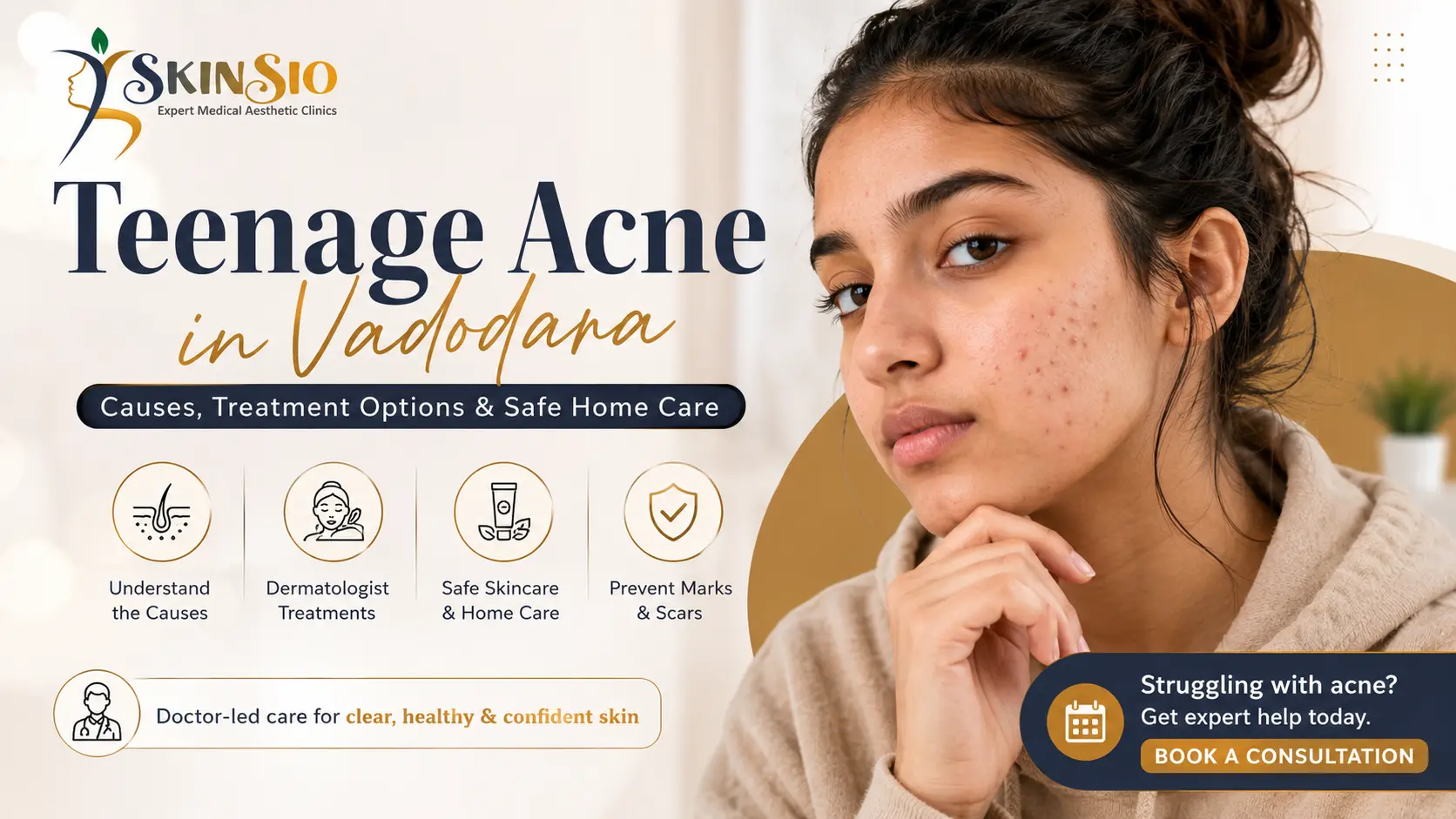
Teenage Acne in Vadodara: What Actually Works?
Acne during the teenage years is extremely common — but that doesn't mean teenagers simply have to "wait for it to go away." Pimples, blackheads, whiteheads, oily skin and occasional painful breakouts can affect confidence, photographs, social interactions and even school or college life. For some teenagers, acne can also leave behind dark marks or scars long after the original pimple has disappeared.
If you're searching for teenage acne treatment in Vadodara, the first step is understanding that acne is not caused simply by being "unclean" or eating one particular food. Teenage acne is usually linked to hormonal changes, increased oil production, blocked pores, inflammation and genetics. The right treatment depends on the type and severity of acne — and on whether marks or scars are already developing.
At SkinSio Clinics, Vadodara, the goal is not simply to dry out individual pimples. A dermatologist-led approach looks at the pattern of acne, its severity, skin type, previous treatments tried, and the risk of pigmentation or scarring — the same evidence-first framework we use across our broader acne treatment guide.
Why Does Teenage Acne Happen?
During puberty, hormonal changes stimulate the sebaceous glands to produce more sebum (oil). When excess oil combines with dead skin cells, pores can become blocked — creating an environment where acne develops, with inflammation contributing to red or swollen lesions.
Several factors influence teenage acne:
- Puberty and hormonal changes — the hormonal shifts of adolescence are one of the primary reasons acne becomes more common during the teenage years
- Naturally oily skin — some teenagers simply produce more facial oil; this doesn't mean the skin is dirty, but excess oil can contribute to blocked pores
- Genetics — if parents or close family members experienced significant acne, a teenager may be more prone to developing it too
- Stress and lifestyle — stress doesn't necessarily "cause" acne, but it may worsen breakouts; irregular sleep and academic pressure can also make consistent skincare harder to maintain
- Skincare and cosmetic products — heavy or pore-clogging products, excessive scrubbing, and layering too many active ingredients can irritate acne-prone skin
- Picking and squeezing — one of the most common mistakes; squeezing inflammatory acne can increase inflammation and contribute to persistent marks or scarring
Does Vadodara's Climate Cause Teenage Acne?
Vadodara's warm weather can make some people feel sweatier or oilier, particularly during hotter months. However, it would be inaccurate to say Vadodara's climate itself directly causes acne. What matters more is how your skin responds to heat, sweat, humidity, skincare products and daily habits.
Leaving sweat on the skin for prolonged periods, repeatedly touching the face, or using heavy products can aggravate acne-prone skin. A simple routine that works consistently in your own environment is generally more useful than constantly changing products based on the season.
What Should Teenagers Do for Acne at Home?
Searching for acne home remedies in Vadodara will bring up plenty of suggestions involving lemon, toothpaste, baking soda, turmeric mixtures and other DIY treatments. Be careful — "natural" does not automatically mean "safe for acne."
A safer home-care routine:
Morning — use a gentle cleanser appropriate for your skin, apply a non-comedogenic moisturiser if needed, apply broad-spectrum sunscreen, and avoid repeatedly touching your face.
After sports or excessive sweating — gently cleanse the skin when practical rather than allowing sweat, oil and dirt to sit on the skin for prolonged periods.
Night — cleanse gently, use any acne medication prescribed for your skin, and moisturise when necessary.
The important principle is consistency rather than complexity. A teenager does not need a 10-step skincare routine to manage acne.
Home Remedies for Acne: What Should You Avoid?
Some popular DIY acne hacks can irritate the skin and potentially worsen pigmentation. Avoid putting these directly on active acne:
- Lemon juice
- Toothpaste
- Undiluted essential oils
- Baking soda
- Harsh scrubs
- Strong alcohol-based products
- Unverified "instant pimple removal" mixtures
Acne-prone skin is already inflamed. Adding irritating substances may damage the skin barrier rather than treat the underlying acne. If you're unsure whether a home remedy is appropriate, it's better to ask a dermatologist than to experiment repeatedly.
Over-the-Counter Products vs Dermatologist Treatment
Mild acne can sometimes improve with appropriate over-the-counter ingredients such as salicylic acid or benzoyl peroxide, depending on the type of acne. However, stronger or prescription treatments may be required for persistent, inflammatory or severe acne.
A dermatologist may consider treatments such as prescription topical medicines, combination acne therapy, oral medicines when clinically appropriate, acne-focused chemical peels in selected patients, procedures for persistent acne, and separate treatment strategies for pigmentation and acne scars. The important distinction is that not every acne treatment is suitable for every teenager — treatment should be selected according to acne type, severity, skin sensitivity and scarring risk.
When Should a Teenager See a Dermatologist?
You don't need to wait until acne becomes severe. Consider a professional consultation if:
- Acne has continued for several months despite basic skincare
- Pimples are painful or deep
- Breakouts are appearing frequently
- Acne is leaving dark marks
- You are developing acne scars
- Your teenager is frequently picking or squeezing pimples
- Acne is affecting confidence or social life
- You are unsure which products are safe
- Multiple products have been tried without improvement
Early assessment can be particularly valuable when there's a risk of permanent scarring — our acne scar treatment guide covers what happens if scarring has already started.
Can Acne Peels Help Teenagers?
Chemical peels are not a universal acne treatment and should not be performed simply because someone has pimples. In selected patients, a dermatologist may recommend an acne-focused peel as part of a broader treatment plan. Depending on the skin and the specific concern, professional peels may help address clogged pores, oiliness, or certain forms of post-acne pigmentation.
The choice of peel, concentration, frequency and suitability should always be determined by a qualified professional. At SkinSio Clinics, chemical-peel treatment is considered as part of an individual's overall skin assessment rather than a one-size-fits-all procedure — see our detailed chemical peel aftercare guide for what recovery actually looks like.
What About Laser Treatment for Teenage Acne?
Laser and light-based procedures can have a role in selected acne-related concerns, but they are not automatically the first treatment for teenage acne. A dermatologist first needs to determine what's actually driving the breakouts and whether medication and appropriate skincare should form the foundation of treatment.
Different technologies suit different indications, so choosing a treatment simply because it's marketed as a "laser acne treatment" isn't the same as receiving an individualised medical recommendation. For teenagers, the priority should always be appropriate diagnosis, acne control, and prevention of scarring first.
Does Food Cause Teenage Acne?
This is one of the most common questions parents and teenagers ask. There isn't one universal "acne diet." Research suggests that dietary patterns may influence acne in some individuals — some people may notice worsening with diets high in refined carbohydrates or certain dairy products. But this doesn't mean teenagers should suddenly eliminate entire food groups.
Instead: maintain a balanced diet, eat a variety of fruits and vegetables, stay adequately hydrated, avoid excessive highly processed foods, and notice whether a particular dietary pattern consistently coincides with worsening acne. Don't replace evidence-based acne treatment with dietary changes alone.
7 Skincare Mistakes Teenagers With Acne Should Avoid
- Washing the face repeatedly — more washing doesn't necessarily mean fewer pimples; excessive cleansing can irritate the skin
- Scrubbing aggressively — acne is not dirt that needs to be scrubbed away
- Changing products every few days — most acne routines require consistency; constant switching can irritate skin and make it hard to know what's actually working
- Popping pimples — increases inflammation and the risk of marks and scars
- Skipping sunscreen — post-acne marks can become more noticeable with UV exposure
- Copying a friend's skincare routine — two teenagers can have completely different acne types and skin sensitivities
- Using social-media "hacks" — a viral skincare trend isn't necessarily medically appropriate for acne-prone skin
Acne Marks Are Not the Same as Acne Scars
This distinction matters. After acne heals, teenagers may notice red or brown marks — these can gradually fade on their own. Acne scars are different: they involve a change in the skin's structure and may appear as depressions, pits or raised areas.
This is one reason controlling inflammatory acne early is so important. Treating established scars is often more complicated than preventing severe acne from progressing to scarring in the first place — our acne scar treatment guide covers exactly how different scar types are approached.
A Better Teenage Acne Treatment Plan
There is no single "best acne treatment" for every teenager. A dermatologist-led plan typically works through these steps:
Step 1 — Assess the acne. Is it primarily blackheads and whiteheads, inflammatory pimples, nodules, or a combination?
Step 2 — Identify triggers and skincare problems. Review current products, habits, cosmetics, sports, sweating and picking.
Step 3 — Start appropriate acne control. Treatment may include topical or oral medication depending on severity and clinical assessment.
Step 4 — Protect the skin barrier. A simple cleanser, moisturiser when needed, and daily sunscreen support treatment rather than undermine it.
Step 5 — Prevent marks and scars. Early acne control and avoiding picking are essential here.
Step 6 — Address residual concerns. Once active acne is controlled, a dermatologist can separately evaluate pigmentation or scarring and decide whether procedures are appropriate.
This sequential approach is generally more sensible than trying multiple procedures simultaneously.
When Parents Should Take Teenage Acne Seriously
Sometimes parents say: "It's just teenage acne. Everyone gets it." While acne is common, severe or persistent acne should not automatically be dismissed as something a teenager simply has to live with.
If acne is painful, persistent, scarring, or affecting a teenager's confidence, professional assessment can make a meaningful difference. The objective isn't to chase perfectly clear skin overnight — it's to control acne safely, minimise inflammation, prevent scarring, and build a skincare routine the teenager can realistically maintain.
Teenage Acne Treatment in Vadodara: Why a Doctor-Led Approach Matters
When choosing an acne clinic in Vadodara, look beyond promotional claims and "instant results." Ask: who will evaluate the acne? Is the treatment customised? Are prescription medicines used when appropriate? Is there a plan to prevent scarring? Are procedures recommended only when suitable? Will someone guide the teenager through skincare, with a proper follow-up plan?
At SkinSio Clinics, Vadodara, acne care is approached with individualised assessment, evidence-based treatment and long-term skin health in mind. For teenagers, the goal is not simply to treat today's breakout — it's to help protect the skin from tomorrow's acne marks and scars. For a broader look at treating acne at any age, see our full acne treatment in Vadodara guide.
Book a Teenage Acne Consultation in Vadodara
Don't chase the next viral acne hack — understand your teenager's skin first. At SkinSio Clinics, Manjalpur, Vadodara, our team can assess acne type, severity, current skincare routine and scarring risk, then build a realistic, medically sound treatment plan. Call or WhatsApp +91 93220 22392 to book a consultation.
Frequently Asked Questions
Is teenage acne normal?
Yes. Acne is extremely common during adolescence because of hormonal and sebaceous-gland changes. However, severe, persistent or scarring acne deserves professional evaluation rather than being dismissed as something to simply wait out.
Are home remedies safe for teenage acne?
Not necessarily. Some popular remedies such as lemon juice, toothpaste and baking soda can irritate acne-prone skin and worsen pigmentation. A simple, consistent, evidence-based skincare routine is generally a much safer approach.
Can I pop a pimple?
It's better not to. Picking and squeezing can increase inflammation and may increase the risk of persistent dark marks or permanent scarring, even though it can look temporarily smaller right after.
How long does acne treatment take to work?
Acne usually does not clear overnight. Improvement typically requires consistent treatment over several weeks to months, and the exact timeline depends on acne severity, type, and the treatment plan being followed.
Should teenagers use prescription acne medication?
Some teenagers benefit from topical or oral acne medicines, but the appropriate treatment depends on the individual's acne type and severity. Prescription medicines should always be used under medical guidance rather than self-prescribed.
Can chemical peels treat teenage acne?
A dermatologist may recommend an acne-focused chemical peel for selected patients as part of a broader plan, but it is not appropriate for every teenager and should never replace the fundamental treatment of active acne with proper skincare and medication.
Does eating chocolate or oily food cause acne?
There isn't strong evidence that a single food like chocolate universally causes acne. Some research suggests diets high in refined carbohydrates or certain dairy products may worsen acne in some individuals, but overall dietary pattern matters more than any one food.
When should I take my teenager to a dermatologist?
Consider a consultation if acne has persisted for several months despite basic skincare, is painful or deep, is leaving dark marks or scars, or is affecting your teenager's confidence — rather than repeatedly experimenting with home remedies or new products.