
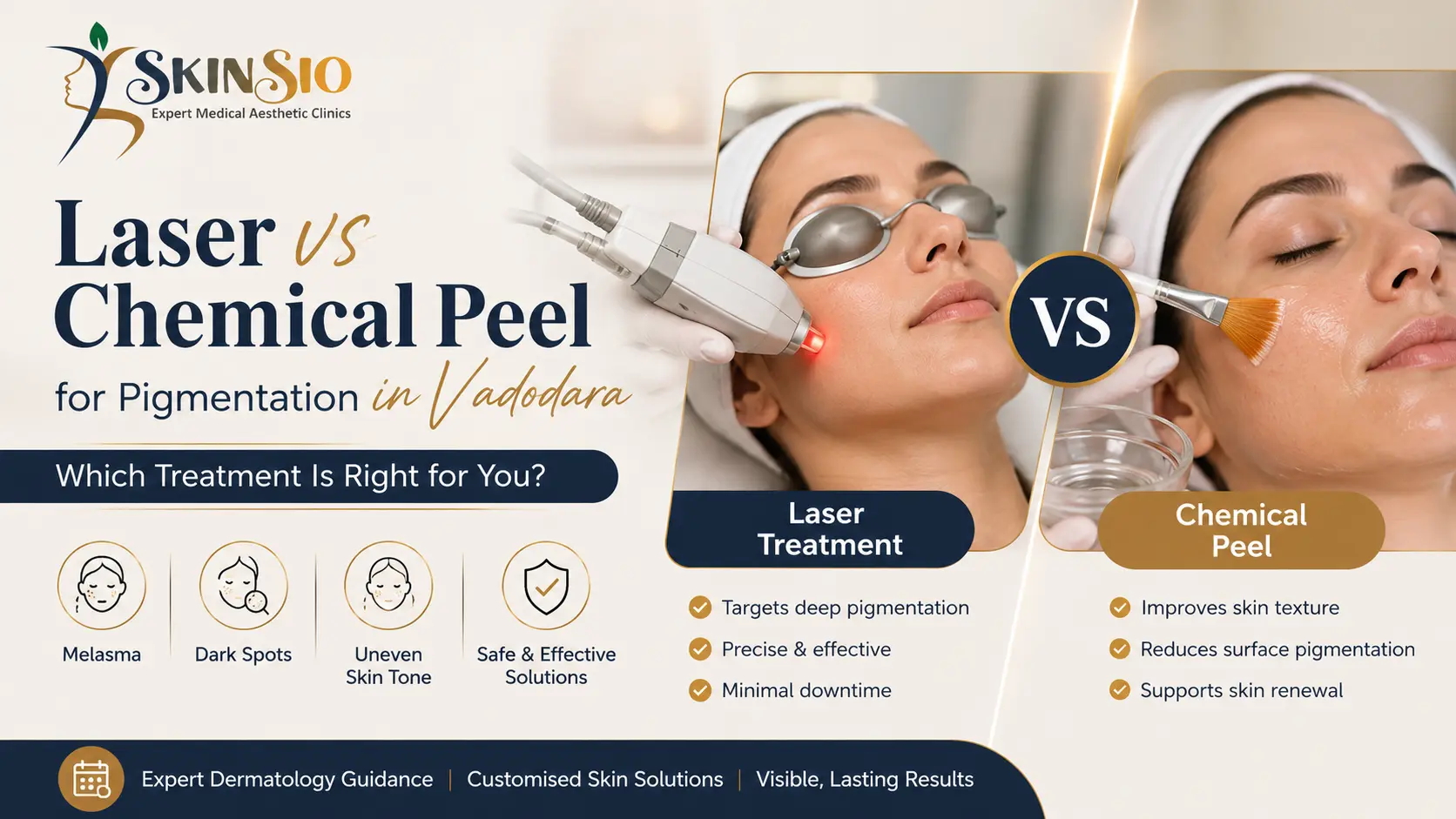
Laser or Chemical Peel: Why This Isn't a One-Size-Fits-All Question
Pigmentation is one of the most common reasons people seek professional skin treatment. Dark spots after acne, uneven skin tone, sun-induced pigmentation, freckles and melasma can all make the skin appear darker or patchy. But they are not the same condition, and that is exactly why there is no single "best pigmentation treatment" that works for everyone.
If you're searching for laser vs chemical peel for pigmentation in Vadodara, you may be wondering: should I choose a laser, or a chemical peel? The honest answer depends on what is causing the pigmentation, how deep it sits in the skin, your skin type, whether you have melasma specifically, any previous treatments you've tried, and your individual tendency to develop post-inflammatory pigmentation after skin irritation.
In some patients, a carefully selected chemical peel may be appropriate. In others, a specific laser or light-based procedure may be considered. And sometimes — particularly when the skin is already irritated or inflamed — neither should be the immediate first step. At SkinSio Clinics, Vadodara, the priority is always identifying the pigmentation first and selecting the treatment afterward, not choosing a procedure simply because it's the newest technology on the market.
First: What Kind of Pigmentation Do You Actually Have?
Before comparing lasers and chemical peels, it's important to understand what you're actually treating. This distinction matters more than almost anything else discussed on this page — our full pigmentation treatment guide covers each type in more depth.
Post-acne pigmentation — dark marks that remain after pimples or inflammation have healed. This is usually epidermal (surface-level) and tends to respond reasonably well to a range of treatments.
Melasma — typically appears as brown or grey-brown patches, often on the cheeks, forehead, upper lip or other areas of the face. It can be influenced by hormonal changes and ultraviolet or visible light exposure. Melasma is particularly important to identify correctly because it can be chronic and prone to recurrence, and it requires a much more cautious treatment approach than other pigmentation types.
Sun-induced pigmentation — repeated UV exposure can contribute to freckles, solar lentigines (sunspots) and generalised uneven pigmentation.
Post-inflammatory hyperpigmentation (PIH) — skin inflammation, acne, aggressive procedures or irritation can trigger increased pigment production as the skin heals. This is especially relevant for Indian skin, because excessive irritation or an overly aggressive treatment can sometimes worsen pigmentation rather than improve it.
This is exactly why diagnosis has to come before treatment.
Chemical Peels for Pigmentation: How Do They Work?
A chemical peel involves applying a carefully selected chemical solution to the skin to produce controlled exfoliation and, depending on the formulation, other biological effects on pigment-producing cells. Common peeling agents include glycolic acid, salicylic acid, lactic acid, Jessner-type formulations, and trichloroacetic acid (TCA) in appropriately selected situations.
The choice isn't simply about picking "the strongest peel." The concentration, formulation, application technique, skin condition and the patient's individual response all matter enormously — a point we cover extensively in our chemical peel aftercare guide.
Potential advantages: for appropriately selected pigmentation concerns, peels can improve uneven skin tone, reduce the appearance of certain superficial pigmentation, improve overall skin texture, address some acne-related concerns simultaneously, and be incorporated into a broader pigmentation-management plan.
Possible disadvantages: depending on the peel selected, there may be temporary redness, peeling or dryness, burning or irritation during application, increased sun sensitivity for a period afterward, and — if the skin isn't appropriately selected or the peel isn't properly managed — a real risk of post-inflammatory pigmentation. Stronger, therefore, does not automatically mean better.
Laser Treatment for Pigmentation: How Does It Work?
Laser treatment uses specific wavelengths of light to target selected structures in the skin. Different lasers have very different applications. Some pigment-targeting lasers interact with melanin or pigment-containing structures directly, while fractional laser technologies work through a different mechanism and are used for selected resurfacing indications rather than pigment removal specifically.
This is an important distinction: there is no single "pigmentation laser." The appropriate technology depends entirely on the diagnosis. A treatment that may be considered for a discrete, well-defined pigmented spot may not be appropriate at all for someone with melasma — and using the wrong device on melasma is one of the more common ways pigmentation gets worse rather than better. Our laser skin treatment guide covers how different laser wavelengths are matched to different skin concerns.
Can Laser Treat Melasma?
This is where the comparison becomes particularly important, and where we want to be especially direct. Melasma is not simply a collection of dark spots that can always be "lasered away." It can be persistent and recurrent, and some laser treatments may actually aggravate pigmentation in susceptible individuals — particularly aggressive, ablative, or high-energy devices used without appropriate caution.
For this reason, melasma management typically involves a broader strategy that may include sun protection, appropriate topical treatment, identification and management of contributing triggers, selected procedures only when clinically appropriate, and long-term maintenance rather than a single fix. Our detailed melasma treatment guide explains exactly why this condition is approached so cautiously. A dermatologist may consider procedural options in selected patients, but laser should never be automatically treated as the first-line answer to every case of melasma.
Laser vs Chemical Peel: What's the Real Difference?
| Factor | Chemical Peel | Laser Treatment |
|---|---|---|
| How it works | A chemical agent produces controlled skin exfoliation and biological effects | Specific light wavelengths target selected skin structures |
| Best suited for | Selected superficial pigmentation, uneven tone, associated acne concerns | Selected pigmentary lesions, depending on diagnosis and technology |
| Downtime | Depends heavily on peel depth and formulation | Depends strongly on the laser/device and settings used |
| Number of sessions | Often performed as a series | May require a series depending on the indication |
| Melasma suitability | Requires careful, conservative selection | Requires particularly careful assessment |
| Risk of pigmentation | Possible, especially after irritation | Possible, particularly with inappropriate settings |
| Customisation | Peel type and concentration can be adjusted | Device, wavelength and parameters can be selected |
The important takeaway: there isn't a universal winner. Neither treatment is inherently superior — the right choice always depends on the specific diagnosis in front of your dermatologist.
Which Is Better for Pigmentation: Laser or Chemical Peel?
Neither laser nor chemical peels are universally better for pigmentation. The appropriate treatment depends on the type of pigmentation, skin type, depth, previous treatments and risk of post-inflammatory pigmentation.
A chemical peel may be considered when: pigmentation is relatively superficial, uneven tone is the primary concern, the skin is clinically suitable for the selected peel, a controlled exfoliation approach is appropriate for the diagnosis, and there are associated concerns such as acne or rough texture that a peel can also help address.
A laser may be considered when: the diagnosis is genuinely appropriate for a particular laser technology, there is a specific, well-defined pigmentary target, the patient's skin type and medical history make the treatment appropriate, and a dermatologist has determined that the expected benefit clearly outweighs the risks.
And sometimes neither is the immediate answer. For example, someone with active inflammation, uncontrolled acne, currently irritated skin, or poorly controlled melasma may benefit from stabilising the skin first — through appropriate topical treatment and sun protection — rather than immediately undergoing a procedure.
What About Indian Skin and Pigmentation?
This is particularly important when considering any pigmentation procedure. Indian and other darker skin types contain more melanin, which can increase the possibility of post-inflammatory hyperpigmentation after skin irritation or injury.
That doesn't mean people with Indian skin cannot undergo chemical peels or laser treatments — it means treatment selection and settings need to be individualised rather than applied as a fixed protocol. A procedure that is entirely appropriate for one person's skin can be unnecessarily aggressive for another's. This is also why online advice such as "this laser removed my pigmentation in one session" should never be treated as a prescription — your pigmentation diagnosis and your skin's individual response matter far more than someone else's unrelated result.
Can Laser and Chemical Peels Be Combined?
Sometimes. A dermatologist may design a combination approach when different treatments address different components of a patient's skin concern — for example, a peel to improve overall texture alongside a laser targeting a specific, well-defined pigmented lesion.
However, combination treatment should never mean performing multiple aggressive procedures simply because more treatment sounds better. The sequence, timing and clinical suitability of each procedure matter enormously, and for certain patients a staged treatment plan — one procedure at a time, with recovery periods in between — is far more appropriate than combining treatments immediately. At SkinSio Clinics, any procedure-based pigmentation plan is built on the individual's skin assessment, pigmentation type, treatment history and how their skin actually responds, not on bundling procedures for the sake of a package.
Is a Patch Test Necessary Before Pigmentation Treatment?
A patch test or small test area may be considered for selected treatments, particularly when there is concern about sensitivity or pigmentary reactions — this is common practice before certain laser or peel treatments on darker or more reactive skin. However, a patch test is not a universal requirement for every laser or chemical peel. The need for testing depends on the treatment, technology, product and clinical situation, and should be determined by a qualified professional rather than requested or skipped by the patient.
How Much Downtime Should You Expect?
Downtime varies considerably between treatments and even between different peels or lasers of the same broad category.
Chemical peel: depending on the formulation and depth, you may experience mild redness, dryness, flaking, peeling, or temporary sensitivity. Some superficial peels have minimal downtime, while deeper peels can require substantially more recovery — sometimes a week or more, as we cover in detail in our chemical peel aftercare guide.
Laser: downtime depends on the particular technology and settings used. Some procedures produce only temporary redness and mild sensitivity, while more aggressive resurfacing treatments can involve considerably longer recovery.
Don't choose a treatment based solely on advertised downtime. A treatment that is genuinely inappropriate for your specific pigmentation can create more problems than the original pigmentation itself — regardless of how quick or "zero-downtime" it was marketed to be.
How Many Sessions Will You Need?
This is another area where advertising can be misleading. Pigmentation is not always eliminated in one session — and any clinic promising a fixed, low session count before assessing your skin isn't giving you an accurate answer. The number of treatments genuinely depends on the type of pigmentation, its depth and distribution, your skin type, the underlying cause, the treatment selected, your response to previous sessions, ongoing sun exposure, adherence to aftercare instructions, and whether the pigmentation has a tendency to recur (as melasma often does).
For conditions such as melasma specifically, maintenance is often an important part of long-term management — not a sign that the initial treatment failed.
Sunscreen Is Part of Pigmentation Treatment
Whether you undergo a chemical peel, laser treatment, or neither, sun protection remains genuinely important. UV exposure can contribute directly to pigmentation formation and may interfere with any effort to maintain improvement you've already achieved.
A comprehensive pigmentation plan should therefore include broad-spectrum sunscreen used daily, appropriate reapplication throughout the day, physical protection such as hats when practical, avoidance of unnecessary intense sun exposure, and careful adherence to any post-procedure sun-protection instructions your provider gives you. For some pigmentation disorders — melasma in particular — visible light can also be relevant, which is why a dermatologist may recommend a tinted, iron-oxide-containing sunscreen strategy tailored specifically to your condition.
What Should You NOT Do Before or After Pigmentation Treatment?
Avoid experimenting with aggressive skincare around any pigmentation procedure without professional guidance. Common mistakes we see include:
- Using multiple exfoliating acids at once — combining several strong actives can irritate the skin unnecessarily
- Scrubbing the skin — pigmentation is not dirt that can be physically scrubbed away
- Picking peeling skin — after a peel or laser procedure, allow the skin to recover according to your prescribed aftercare, without pulling or scratching
- Skipping sunscreen — UV exposure can worsen pigmentation and undo the results of any treatment
- Getting treatments from unqualified providers — lasers and chemical peels are medical and aesthetic procedures where inappropriate selection or settings can cause burns, irritation or pigmentary complications
- Copying someone else's treatment — your pigmentation may not be the same condition as theirs, even if it looks similar
So, Laser or Chemical Peel — Which Should You Choose?
Instead of asking "which treatment is best?", the more useful question is "which treatment is appropriate for my specific pigmentation?" That difference genuinely matters.
A dermatologist may recommend a chemical peel if the pigmentation and skin condition are clinically suitable for it; a laser if a particular technology is appropriate for the diagnosed concern; topical treatment plus sunscreen when controlling the underlying pigmentation is the immediate priority; combination or staged treatment when different approaches can safely address different components of the concern; or no procedure initially when the skin genuinely needs to be stabilised first.
The best pigmentation treatment is therefore not necessarily the most expensive, the strongest, or the newest procedure available — it is the one that is appropriate for the diagnosis and your skin's individual risk profile.
Pigmentation Treatment in Vadodara: What Should You Look For?
If you're considering pigmentation treatment in Vadodara, don't choose a clinic simply because it advertises a particular laser or promises "permanent pigmentation removal." Instead, consider whether the clinic properly evaluates the type of pigmentation you actually have, considers your skin type before recommending anything, reviews your previous skincare and procedures, explains expected results realistically rather than with vague promises, discusses possible side effects openly, provides appropriate pre- and post-treatment care, has a genuine strategy for preventing recurrence — particularly for melasma — and recommends procedures only when they're clinically appropriate rather than as a default upsell.
At SkinSio Clinics, Vadodara, the approach begins with understanding the skin concern rather than automatically recommending a particular machine or procedure — the same principle we apply across our complete pigmentation treatment guide, our melasma treatment guide, and our guide to choosing a skin clinic in Vadodara.
Book a Pigmentation Consultation in Vadodara
Ready to understand what's actually causing your pigmentation, rather than guessing between a laser and a peel? At SkinSio Clinics, Manjalpur, Vadodara, our team assesses your pigmentation type, skin tone and history before recommending any treatment — never the other way around. Call or WhatsApp +91 93220 22392, or visit us on Makarpura Road near D-Mart to get started.
Frequently Asked Questions
Is laser better than a chemical peel for pigmentation?
Not universally. The appropriate treatment depends on the type of pigmentation, skin type, depth, previous treatments and risk of post-inflammatory pigmentation. A dermatologist should assess your specific pigmentation before recommending either option.
Which is safer for Indian skin: laser or chemical peel?
Both can be used appropriately in Indian skin, but both can also cause irritation or pigmentation changes if poorly selected or performed. Individual assessment and conservative treatment planning are important, particularly for Fitzpatrick III–V skin.
Can chemical peels permanently remove pigmentation?
Not necessarily. Some pigmentation can recur, particularly when the underlying trigger continues, such as ongoing sun exposure or hormonal factors. Sun protection and maintenance are often an important part of a long-term plan.
Can laser permanently remove melasma?
Melasma can be chronic and recurrent. Laser treatment is not a guaranteed permanent cure and is not appropriate for every patient — inappropriate laser use can sometimes aggravate melasma in susceptible individuals.
How many chemical peels are needed for pigmentation?
There is no fixed number. The number and interval depend on the specific peel, the pigmentation being treated, skin type and individual response, and should be determined by your treating dermatologist.
How many laser sessions are required for pigmentation?
It varies according to the laser technology used and the condition being treated. A dermatologist should determine the treatment schedule after assessing your pigmentation type and depth.
Can I do a chemical peel and laser on the same day?
Not automatically. Combining procedures can increase irritation and pigmentary risk in some patients. Whether treatments can be safely combined, and in what sequence, depends on the specific treatments and your skin's response.
Can pigmentation become darker after treatment?
Yes. Irritation and inflammation from procedures can sometimes cause post-inflammatory hyperpigmentation, particularly in individuals prone to pigmentation. Appropriate patient selection, conservative treatment parameters and proper aftercare are important to minimise this risk.
What is the best pigmentation treatment in Vadodara?
There isn't one treatment that's best for everyone. The appropriate option depends on whether the concern is melasma, post-acne pigmentation, sunspots, or another pigmentary condition — which is why diagnosis should always come before treatment selection.